

Bio - Herbicidal Potential of Mustard (× Brassarda juncea (L.) Su Liu & Z.H. Feng) Seed Residues against selected Weed species
Bhaswati Kakati
Department of Botany, Anandanram Dhekial Phookan College, Nagaon
Corresponding author: b.kakati8@gmail.com
Abstract
The present paper deals with the study of potential inhibitory effect of seed residue extract of Indian brown Mustard (× Brassarda juncea (L.) Su Liu & Z.H. Feng) on weeds seeds and its potential use in crop cultivation. In this experiment aqueous extracts were prepared from discarded mustard seed residue after oil extraction and test plants are selected as Mikania micrantha Kunth, Amaranthus viridis L. and Ageratum conyzoides L. in which germination and radical development tests were performed. During the study response of test plants was found in all levels of extract, with different proportions.
Key words: Allelopathy, aqueous extracts, germination index, mustard seed cake.
Introduction
Plants growing in close proximity usually show either inhibitory or stimulatory effect on the growth and development of other neighboring plant species and the process is known as allelopathy (Levin, 1976). Allelopathy is a phenomenon where a plant species chemically interfere with the germination, growth and development of other plant species in their vicinity and has been known for over 2000 years (Mushtak et.al., 2020). The term allelopathy generally refers to the unfavourable effect of higher plants of a species on the germination and growth of the other species (Kakati, 2025; Kakati, 2015; Kakati & Baruah, 2013).
Almost all the plants are capable of producing various kinds of secondary metabolites (such as alkaloids, isoprenoids, phenolics, flavonoids, terpenoids and glucosinolates) and Some of these secondary metabolites can act as alle-chemicals (Kumar et. al., 2025). Compounds with allelopathic activity are present in many plant organs including leaves, stems, fruits, seeds and buds (Mahall & Callaway, 1991). Allelopathy appears to be a crucial constituent of plant interference capability in a variety of natural and man-made ecosystems.
Mustard is one of the most commonly cultivated plants in Assam. Oil extracted from brown mustard seeds is known for its high quality and popularity among Indian people. During the process of oil extraction, a significant amount of seed residue are left behind which are usually either discarded without utilizing its potential use or user as fermented organic manure in plant cultivation. But another potential value of mustard cake is to utilize it as organic weedicide (Dola, 2024). Mustard posses a great variety of allelochemicals that are left behind in seed residues during oil extraction which can be used to inhibit germination, growth and spread of some specific cropland weeds, without effecting the potential productivity of the desired crops. Mustard seeds contain a few effective allelochemicals like Glycosinolates that break down to form toxic derivatives of Isothiocyanates like Benzyl- Isothiocyanates and ionic- Isothiocyanates that shows significant efficiency as potent herbicide and insecticide, that can inhibit both germination and growth of weed and pests (Tark and Tawaha, 2003). Brown mustard seeds also contain phenolic compounds like Ferulic acid and Syringic acid and volatile compounds like Isoprenoids and Benzenoids as allelochemicals (Saeedipour, 2010).
Mikania micrantha, Amaranthus viridis and Ageratum conyzoides are some of the very common weeds found in Indian crop fields that cause immense harm to the economically important crop’s productivity and quality as these weeds are known for their potent inhibitory chemicals (Lalrindiki1, 2020, Kumari and Jaiswal, 2022). Therefore, in common practice chemical weedicides are usually applied in crop fields to suppress these harmful weeds. But this process in long run irreversibly harms the soil quality and also potential production of the desired plants.
Keeping the above in view, in the present work, some observations were made on the allelopahic potential of mustard seed residue on the germination and growth of some common weed plants seeds, which can be grown easily in Patri dishes laboratory condition.
Materials and Methods
Collection and preparation of plant material
Fresh seed residues of mustard (Mustard cake) were collected from oil pressing mills from the nearby localities and the seeds of Mikania micrantha, Amaranthus viridis and Ageratum conyzoides are collected from local crop fields and wild vegetations. An aqueous extract of mustard seed cake was made by preparing a paste of 5 gm of fresh seed residue in 50 ml distilled water and aqueous extract was obtained as filtrate. This gave 10% aqueous extract. This extract was diluted again with distilled water to get 5%, 2% and 1% aqueous extracts.
Seed germination and root development study
Germination tests were performed for the aqueous extract of test plants. Healthy and uniform sized seeds were selected and pre-soaked in distilled water for 2 hrs and then soaked in 10%, 5%, 2% and 1% aqueous solution for 3 hrs and double distilled water is treated as control set up. Seeds were placed on double layer of filter paper in sterilized Petri dishes. The Petri dishes were placed in dark place at room temperature (about 24-29°C). Each treatment has three replicas and one was run as controlled with distilled water. Germination was determined by counting the number of germinated seeds at 24 hr intervals over a four-day period. The lengths of the radicle of germinated seed were measured by using a manual Vernier Scale after 48 hours of exposure. Various parameters are calculated by using standard formula ISTA (International Seed Testing Association).
Seed germination percentage (%)
The determination of seed germination (%) was made:
Seed germination (%) = (Total germinated seeds/ total number of seed considered) x 100
Germination index
Germination index (GI) was determined by standard formula as given by Association of Official seed Analysts (Anon., 1983).
Germination index (GI) = Seeds which were germinated at first count + Number of seeds which were germinated at last count / Days of first count + days of final count
Germination Energy (GE)
Germination energy is the percentage of number of seeds that germinates in a definite period of time. It indicates how fast and uniformly seedlings emerge from seed in unit time. Usually, Germination energy is calculated in 4 days, 7 days or 14 days intervals.
Formula for Germination energy is
GE= (number of seeds germinated in nth day / total number of seeds tested) x 100
Results and Discussions
Allelopathy is considered as both harmful and beneficial interactions among plants (Rizvi & Rizvi, 1986). The results in the present experiment showed gradual decrease in germination in all plants with the response to various concentration of mustard seed residue extract in different degree in test plants. The effect of aqueous seed residue extract of Mustard on the germination and seedling growth of Mikania micrantha, Amaranthus viridis and Ageratum conyzoides shown in the Table: 1 and Table: 2. Significant differences in seed germination in each setup were observed. Distilled water (control) showed maximum germination rate among all the setups and after 72 hrs, it showed nearly 100% germination in each case. Amongst different concentrations of the seed residue extracts, 10% solution showed maximum effect whereas 1% solution showed that of minimum influence in each case. This result was in corroboration with some earlier works by Bora et.al. (1999), Siddiqui et. al. (2009). During the present study, it was seen that Mikania micrantha seeds showed more sensitivity towards allelochemicals of Mustard than that other two. In the first day of study Mikania micrantha seeds showed maximum inhibition with single seed germination out of 20 test seeds in case of 10% solution of extract.
The inhibition in root length of target plant species in response to allelochemicals is a good indicator of phytotoxicity which was proven by multiple prior studies (Rafiqul Hoque et al., 2003; Khan et.al. 2004; Amoo et.al., 2008,).
In the present study it was also observed that the effect of aqueous extract of the test plants on the radicle length was also very significant. Table 2 showed highest radicle length in case of control and that of lowest in 10% extract solution of Mustard cake residue in all the test seeds. Other concentrations showed results in between these two extremes. Moreover, it was observed that after initial start, radicle growth inhibition was weaken gradually and after 5 or 6 days, radical start to grow normally. Further investigation suggested that after partial decomposition of mustard seed extract, it acts a growth booster for plant roots in lower concentration.
During the study, it was observed that the allelopathic effects of the patron plants are more prominent in the observation of germination and early root development in higher concentration. This showed that in lower concentration only germination inhibition is effective whereas radical growth after a critical period of time shows no significant result.
Germination percentage is an estimation of the viability of a population of seeds. It was highest in control and lowest in 10% solution in all cases and it increases with respect to observation time (Graph:1). Germination percentage was significantly correlated to total number of seed germinated in all cases.
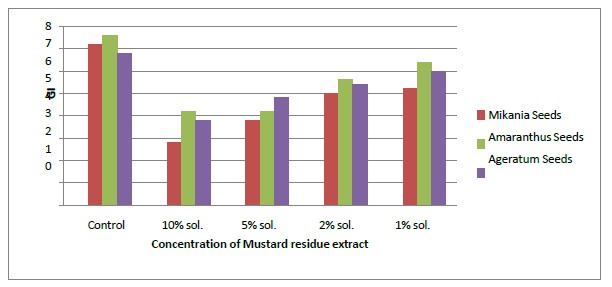
Germination index on the other hand indicates the potential of germination of a particular species in specific growth conditions. In this study it showed that Germination index is high in control and 1% concentrated solution in all test seeds, which were about 8 in the scale of 1 to 10. That means allelopathic chemicals have negligible effect on seed germination in very low concentration but as concentration increase the germination index decreases eventually. It showed lowest value in case of Mikania micrantha seeds in 10% concentration followed by 5%. It also revealed the fact that Mikania micrantha seeds suffered more inhibition effect than Amaranthus viridis seeds and Ageratum conyzoides seeds in the present study (Graph: 2).
Table 1: Effect of aqueous seed residue extract of mustard plant on the germination of Mikania micrantha, Amaranthus viridis and Ageratum conyzoides
| Time (hrs.) |
Mikania Seeds | Amaranthus Seeds | Ageratum Seeds | ||||||||||||
|---|---|---|---|---|---|---|---|---|---|---|---|---|---|---|---|
| Control | 10% sol. | 5% sol | 2% sol | 1% sol. | Control | 10% sol. | 5% sol. | 2% sol | 1% sol | Control | 10% sol. | 5% sol | 2% sol | 1% sol | |
| 24 | 16 | 1 | 5 | 9 | 10 | 18 | 5 | 6 | 10 | 13 | 14 | 7 | 9 | 11 | 12 |
| 48 | 19 | 6 | 6 | 11 | 12 | 20 | 7 | 8 | 12 | 15 | 18 | 9 | 12 | 13 | 13 |
| 72 | 20 | 11 | 13 | 15 | 15 | 20 | 12 | 13 | 15 | 16 | 20 | 12 | 13 | 15 | 17 |
| 96 | 20 | 13 | 14 | 16 | 16 | 20 | 16 | 15 | 18 | 19 | 20 | 12 | 15 | 16 | 18 |
NB: Sol.= Solution
Table 2: Effect of aqueous seed residue extract of Mustard plant on the radical growth of Mikania micrantha, Amaranthus viridis and Ageratum conyzoides (in cm)
| Time (hrs) | Mikania Seeds | Amaranthus Seeds | Ageratum Seeds | ||||||||||||
|---|---|---|---|---|---|---|---|---|---|---|---|---|---|---|---|
| Control | 10% sol. | 5% sol. | 2% sol. | 1% sol. | Control | 10% sol. | 5% sol. | 2% sol. | 1% sol. | Control | 10% sol. | 5% sol. | 2% sol. | 1% sol. | |
| 48 | 1.23 | 0.87 | 0.93 | 1.03 | 1.2 | 1.83 | 0.83 | 1.03 | 1.23 | 1.26 | 1.28 | 0.78 | 0.9 | 1.11 | 1.18 |
| 72 | 2.6 | 1.43 | 2.4 | 2.3 | 2.1 | 2.85 | 1.4 | 1.7 | 1.77 | 2.6 | 1.97 | 1.11 | 1.26 | 1.76 | 1.78 |
| 96 | 4.16 | 2.02 | 2.7 | 2.3 | 4.1 | 3.83 | 1.54 | 1.67 | 2.11 | 3.51 | 3.05 | 1.46 | 1.8 | 2.2 | 2.82 |
NB: Sol.= Solution
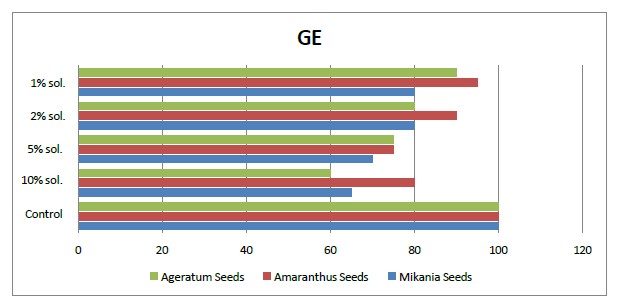
Germination energy is the percentage of number of seeds that germinates in a definite period of time. It indicates how fast and uniformly seedlings emerge from seed in a definite time. Usually, Germination energy is calculated in 4 days, 7 days or 14 days intervals. In the present study it was calculated in 7 days period. Here germination energy was recorded maximum in each test plants as normal. Lowest germination energy was observed in Ageratum seeds with treatment in 10% extract solution followed by Mikania seeds. Germination energy gradually increases with the lowering in concentration (Graph:3).
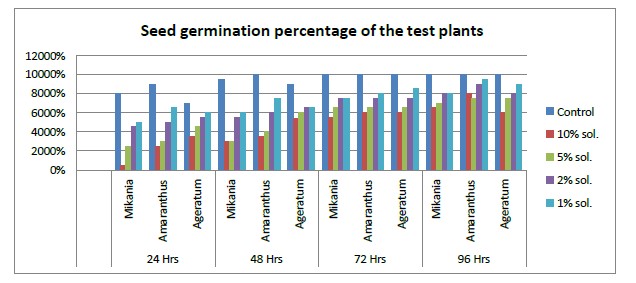
Graph1: Bar diagram showing seed germination percentage of aqueous seed residue extract of Mustard plant on the germination of Mikania micrantha, Amaranthus viridis and Ageratum conyzoides
Conclusion
In Assam, Brown Mustard is usually used as the most widely used oil source and widely cultivated all over the state. These are also used in medicine, spice and as leafy vegetable and in various traditional practices. A significant amount of residue is obtained after extraction of oils that are partially used as “Sarioh Khali or Kharoli” as spicy food condiments or as organic growth stimulator in plants after fermentation. But still a major portion was discarded or burned to dispose each year losing a high potential.
The present study revealed that seed germination and seedling growth of Mikania micrantha, Amaranthus viridis and Ageratum conyzoides seeds was suppressed by different concentration of seed cake extract of Mustard. Among the three test seeds, Mikania micrantha suffered strong inhibition by phytotoxicity and allelochemicals of mustard seed residue extracts. In previous studies by other workers (Tark and Tawaha, 2003; Saeedipour, 2010) also mustard showed significant allelopathic effect on various test plant’s seed germination and seedling growth.
Thus, it indicates that many plants including harmful weeds may also be sensitive towards seed residue extracts of Mustard. Therefore, this plant can also be used as important source of natural Bio-herbicides to control weeds in those crop fields that are relatively less sensitive or nearly tolerant to mustard seed residue extract.
Declarations
Conflict of Interest: The authors declare that they have no conflict of interest.
References
- Amoo, S.O., Ojo, A.U. & Staden, J.V. (2008). Allelopathic Potential of Tetrapleura tetraptera Leaf Extracts on Early Seedling Growth of Five Agricultural Crops. South. African Journal of Botany. 74: 149-152.
- Bora, I.P., Singh J., Borthakur R. & Bora E, (1999). Allelopathic Effect of Leaf Extracts of Acacia auriculiformis on Seed Germination of Some Agricultural Crops. Annals of Forestry, Vol. 7: 143-146.
- Dola N. A., Sarker U.K., Md., Ahmed M.T., Upama S.A., Rashid M.H.O., Uddin M.R. (2024). Comparative advantages of aqueous extract of mustard crop residues with herbicide to weed control and crop performance of wheat. Archives of Agriculture and Environmental Science. Vol 9(2): 294-301. https://doi.org/10.26832/24566632.2024.0902013.
- Lalrindiki J.C.A & Lalnunmawia F. (2020). Allelopathic effects of Mikania micrantha on agricultural crops in Mizoram, North-East India. International Journal of Life Science Research. Vol. 8, Issue 4, pp: 10-13.
- Kakati, B. and Baruah, A. (2013). Allelopathic Effect of Aqueous Extract of Some Medicinal Plants on Seed Germination and Seedling Length of Mung Bean (Vigna radiata (L.) Wilczek.). Indian Journal of Plant Sciences Vol. 2(3): 8-11.
- Kakati, B. (2015). A Study on the Allelopathic Effect of a Few Common Weeds on Seed Germination and Radical Length of Mung Bean (Vigna radiate (L.) wilczek.). Chirantan Chintan (ISSN 2278-4756), Vol. 4 (1): 157-161.
- Kakati, B. (2025). Inhibitory Effect of Eichhornia and Lemna on Germination Parameters and Seedling Development of Two Economically Important Plants of India. In D. Borgohain (Ed.) Emerging Paradigms in Biological Sciences. (Pp 62-69). National Press Association.
- Khan, M.A., Marwat, K.B. and Hassan, Z. (2004). Allelopathic Potential of Some Multipurpose Trees Species (MPTS) on the Wheat and Some of its Associate’s Weeds. International Journal of Biology and Biotechnology., Vol. 1(3): 275-278.
- Kumar P., Kumar D., Pal S., and Singh S. (2025). Plant secondary metabolites in defence against phytopathogens: Mechanisms, biosynthesis, and applications. Physiological and Molecular Plant Pathology. Vol. 138. Article 102639, 10.1016/j.pmpp.2025.102639.
- Kumari A. and Jaiswal P.K. (2022). Allelopathic impact of Ageratum conyzoides L. extract on seed and seedling traits of Vicia faba L. International Journal of Creative Research thoughts. Volume 10, Issue 2: 81-89.
- Levin, D.A. (1976). Molecular Evolution and Organismal Evolution. Annual Review of Ecology and Systematics.7: 121-157.
- Mahall, B.E. and Callaway, R.M. (1991). Root Communication Among Desert Shrubs. Proceedings of the National Academy of Science of the United State of America, Vol. 88. Pp. 874-876.
- Mushtaq, Siddiqui W., Hakeem M.B. & Rehman K. (2020). History of Allelopathy. Allelopathy. Springer Briefs in Agriculture. Springer, Cham. https://doi.org/10.1007/978-3-030-40807-7_2
- Rafiqul Hoque A. T. M., Ahmed R., Uddin M. B. & Hossain M. K. (2003). Allelopathic effects of different concentration of water extract of Eupatorium odoratum leaf on germination and growth behavior of six agricultural crops. Journal of Biological Sciences. 3 (8): 741-750.
- Rizvi, S.J.H. and V. Rizvi, (1986). Allelopathy: Some New Terminological Considerations. Current Science., 85: 191–192.
- Saeedipour S. (2010). Allelopathic Effect of White Mustard (Sinapis alba) on Germination and Growth of Wheat (Triticum aestivum L.). International Journal of Applied Agricultural Research. Vol. 5(1), 47-53.
- Siddiqui, S, Yadav R, Yadav K., Ahmad, F.W., Meghvansi, M.K., Sharma S. & Jabeen F., (2009a). Phytotoxic Effects of Some Agro-forestry Trees on Germination and Radicle Growth of Cicer arietinum var. Pusa-256. Global Journal of Environmental Research, Vol. 3(2): 87-91.
- Tark M.A. & Tawaha, A. M. (2003). Allelopathic Effect of Brown Mustard (Brassica nigra L.) on Germination and Growth of Wild Oat (Avena fatua L.), Crop Protection; vol. 22 (4): 673-677.
**************