
Orchid Diversity of Udalguri District, Assam, India
Anaru Boro
Department of Botany, Tangla College, Assam
Corresponding author: dranaruboro@gmail.com
Abstract
The plant group, Orchid is one of the well-known for its aesthetic beauty and long last blooming. This group of plants are highly explored and collected from wild habitat for their diverse values. The reserve forests of Udalguri district were very rich in flowering plants and many important species were seen decreasing at present due to diverse developmental activities such as small industrial development viz., small tea gardens as well as rubber plantation. So, a survey was conducted to enumerate the orchid flora of the district. In present survey, a total of 21 species had been recorded from the area. All the recorded species had been found under threat.
Key words: Orchid, Diversity, Udalguri district
Introduction
The orchids belonging to Orchidaceae family of monocot group are largest flowering plants having about 25000 species under 880 genera (Cribb et al., 2003). There are about 1331 species that belong to 186 genera and of which 328 species under 100 genera has been reported from Assam (Barooah & Ahmed, 2014). A total of 32 species under 25 genera had been reported from entire BTAD areas (Borthakur et al., 2018). The orchid flora of Udalguri district has been very little explored. Only a few species had been recorded as distribution in the district (Boro, 2017).
Udalguri district is located in the central part of the state Assam on the northern bank of Brahmaputra River along the foothills of Himalaya. Udalguri was declared as a separate district on 30 October 2003 with Govt. Notification No. GAG (B)-137/2002/Pt/117. It is situated in between the Latitudes between 26°30′N and 27° 0′N and Longitudes between 91°08′E and 92°20′ E. The district occupies an area of 1852.16 km². It is bounded by Bhutan and West Kameng district of Arunachal Pradesh state in the north, Sonitpur district in the east and Darrang district in the south and Baksa district in the west. The district is inhabited by multi-lingual and multi-cultural groups of people. The Bodo-Kacharis and Rabhas are the local inhabitant tribe of the district (Borthakur et al., 2018).
Physiographically the district can be divided into two parts-plain region and foothill region. The most part of the district adjoining the northern border of foothills of Indo-Bhutan border form the plain belt of the district. This area forms the agricultural land of the district. The small patches of hills along the northern border forms the foothill region. The general climate of the district is sub-tropical and humid. In the northern part of the district, the temperature is comparatively low and experienced heavy rainfall than other part of the district. The total area of reserved forest is about 17216 ha (Barnadi Wildlife Sanctuary, Bhairabkunda, Khalinguar, Rowta and Newlee).
The forest types and sub types observed in the Udalguri district are come under tropical and sub-tropical forests. Tropical semi-evergreen and moist mixed deciduous Forest types are observed in patches along the Indo-Bhutan border of Barnadi W.S., Khalingduar and Bhuirupkundo reserve forests. Mix deciduous (Agri plantation/settlement) type of forests occupies a large area in the district. A forest in which the trees are mostly deciduous but few evergreen and semi-evergreen plants are also observed scattered. There are patches of pure grassland in Barnadi wildlife sanctuary along with sparsely distributed medium to short trees that forms Savannah ecosystem (Champion & Seth, 1968).
Material and Method
The present study on Orchid diversity of Udalguri district was undertaken during 2020-24 as part of floristic exploration of the district. Plant specimens were collected with reproductive parts such as flowers, fruits along with vegetative parts covering all seasons. Herbarium specimens were prepared following techniques of Jain and Rao (1977). The herbarium sheets were deposited in the department of Botany, Tangla College, Tangla. Identification of the plant specimens were made by comparing field observation and description with relevant literatures (Karthikeyan et al., 1989; Chowdhery, 1998, 2009; Barua, 2001; Lucksom, 2007; Barooah and Ahmed, 2014; Rao and Singh, 2015; Borthakur et al., 2018) and counter checked, confirmed by consulting authenticated herbarium sheets preserved in ASSAM and GUBH. G.U. Digital herbarium sheets from Kew (www.apps.kew.org) and FLAS (www.flmnh.ufl.edu) have also been consulted during the study. Nomenclatures have been checked with recent available literatures in the library of Botanical Survey of India, Shillong and cross checked with the help of online websites like www.worldfloraonline.org, and www.ipni.org.
Result and Discussion
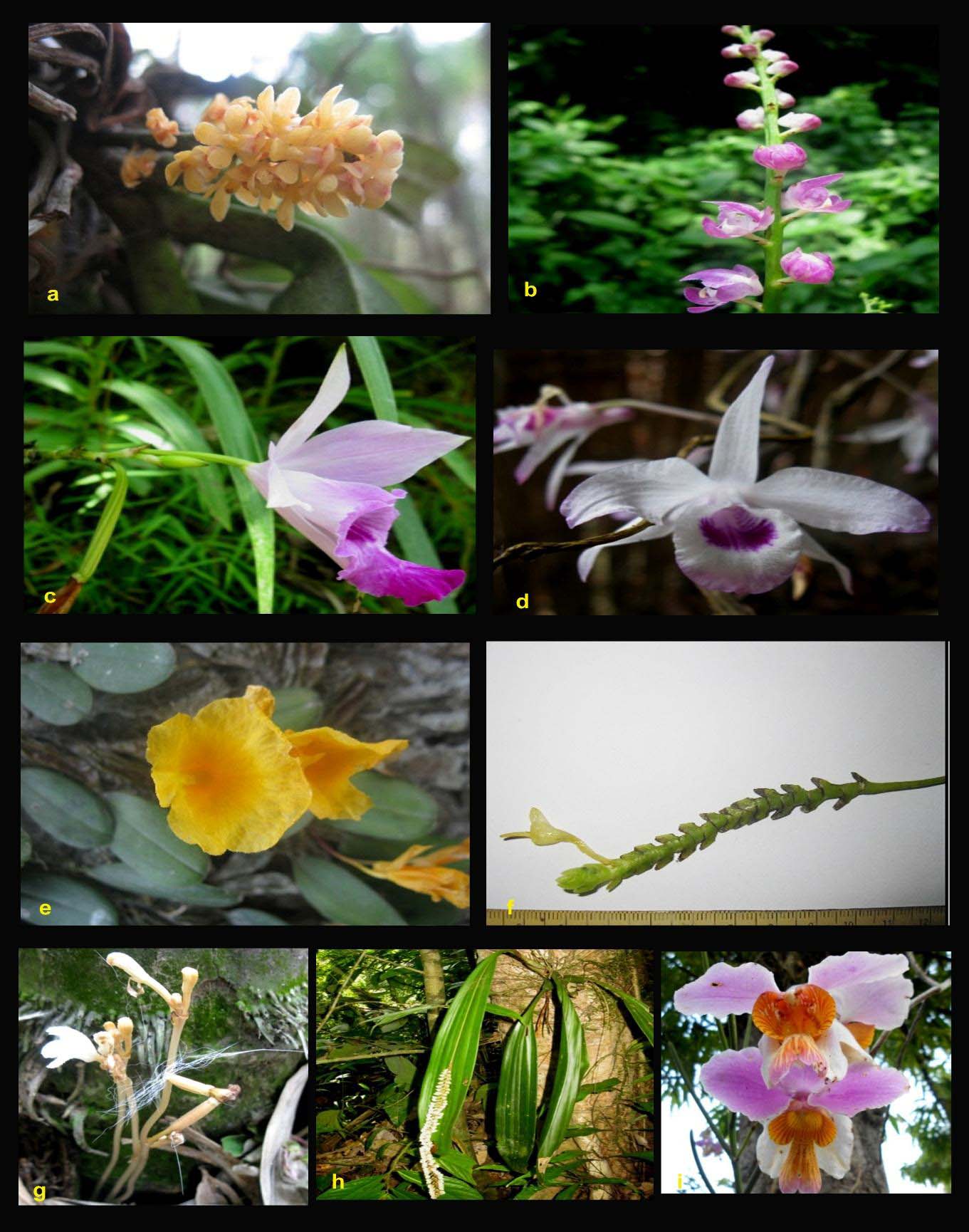
In the present study a total of 21 species under 16 genera had been recorded from the Udalguri district (Table 1). Out of 21 species, 4 species were terrestrial, 16 species were epiphytic and 01 saprophyte.
Table 1: List of Orchids of Udalguri district
| SL. No. | Name of Taxon | Habit | Conservation Status | Distribution in Assam (Kataki, 1988; Barooah & Ahmed, 2014) |
|---|---|---|---|---|
| 1 | Acampe papillosa (Lindl.) Lindl. |
Epiphytic | EN€ P* | Throughout Assam |
| 2 | Aerides multiflorum Roxb. |
Epiphytic | DD¥/EN€/P* | Barak Valley, Eastern Assam, Western Assam, Karbi Anglong, Udalguri |
| 3 | Aerides odorata Lour. | Epiphytic | DD¥/EN€/P* | Barak Valley, Eastern Assam, Western Assam, Udalguri |
| 4 | Arundina graminifolia Hochr. | Terrestrial | DD¥/VU€/P* | Barak Valley, Eastern Assam, Western Assam, Udalguri |
| 5 | Bulbophyllum careyanum (Hook.) Spreng. |
Epiphytic | DD¥/EN€/P* | Barak Valley, Kamrup, Golaghat, Bongaigaon, Dibru Saikhowa, Manas National Park, Reserve, Goalpara, Lakhimpur, Udalguri |
| 6 | Calanthe sylvatica (Thouars) Lindl. |
Terrestrial | DD¥/EN€/P* | Dibrugarh, Dhemaji, Lakhimpur, Udalguri |
| 7 | Cymbidium aloifolium (L.) Sw. |
Epiphytic | DD¥/EN€/P* | Throughout Assam |
| 8 | Dendrobium aphyllum (Roxb.) Fischer |
Epiphytic | DD¥/EN€/P* | Throughout Assam |
| 9 | Dendrobium lindleyi Steud. |
Epiphytic | DD¥/EN€/P* | Barak Valley, Golaghat, Kaziranga National Park, Kamrup, Sivasagar, Udalguri |
| 10 | Dendrobium jenkensii Lindl. |
Epiphytic | DD¥/EN€/P* | Manas National Park, Barak Valley, Bongaigaon, Kamrup, Lakhimpur, Golaghat, Udalguri |
| 11 | Dendrobium moschatum (Buch.-Ham.) Sw. | Epiphytic | DD¥/EN€/P* | Barak Valley, Darrang, Dibru Saikhowa Biosphere Reserve, Joypur Reserve Forest, Kamrup, Golaghat, Goalpara, Lakhimpur, Sivasagar, Udalguri |
| 12 | Dendrobium spetella Rchb.f. |
Epiphytic | DD¥/EN€/P* | Baksa, Chirang, Barpeta, Bongaigaon, Golaghat, Jorhat, Nalbari, Udalguri, Kokrajhar |
| 13 | Didymoplexis pallens Griffith. |
Saprophyte | EN€ P* | Throughout Assam |
| 14 | Eria bractescens Lindl. |
Epiphytic | DD¥ P* | Throughout Assam |
| 15 | Flickingeria fugax (Rchb.f.) Seidenf. |
Epiphytic | DD¥/EN€/P* | Joypur Reserve Forest, Kamrup, Nalbari, Udalguri |
| 16 | Geodorum densiflorum (Lam.) Schltr. |
Terrestrial | DD¥/EN€/P* | Throughout Assam |
| 17 | Papilionanthe teres (Roxb.) Schltr. |
Epiphytic | DD¥/VU€/P* | Throughout Assam |
| 18 | Pholidota imbricata Lindl. |
Epiphytic | DD¥/VU€/P* | Barak Valley, Darrang, Kamrup, Udalguri |
| 19 | Rhynchostylis retusa (L.) Bl. |
Epiphytic | R¥/VU€/P* | Throughout Assam |
| 20 | Vanda cristata Wall. ex Lindl. |
Epiphytic | CR¥ P* | Throughout Assam |
| 21 | Zeuxine strateumatica (L.) Schlechter |
Terrestrial | DD¥/EN€/P* | Barpeta, Bongaigaon, Darrang, Golaghat, Jorhat, Kamrup, Nalbari, Udalguri |
NB: CR- Critically endangered, EN- Endangered, R-Rare, VU- Vulnerable, NE-Not Evaluated, DD- Data Deficient ¥ - Conservation status of plants of Assam recorded from sources other than IUCN, € - Conservation status of plants of Assam according to IUCN, P*- Plants prohibited for trade by Convention on International Trade in Endangered Species of Wild Fauna and Flora (CITES)
species viz. Didymoplexis pallens found in saprophytic habit under shades large trees and bamboo plantation. Of the 16 genera, Dendrobium was represented by 5 species followed by Aerides with 2 species. The terrestrial species like Geodorum densiflorum and Zeuxine strateumatica were only spotted in Barnadi wildlife sanctuary in the district. Dendrobium spetella was found to be endemic to Assam among the identified species (Chowdhury, 2005). All the present recorded orchid species from the study area were recognized as RET taxa under CITES (Chowdhery and Murti, 2000; Chowdhury, 2005; Barooah and Ahmed, 2014).
Artocarpus chama Buch.-Ham., A. lacucha Buch.-Ham., Bischofia javanica Bl., Bombax ceiba L., Bridelia retusa (L.) Spreng., Castanopsis purpurella (Miq.) Balakr., Dillenia indica L., Dillenia pentagyna Roxb., Duabanga grandiflora (Roxb. ex DC.) Walp., Dysoxylum binectariferum (Roxb.) Hook.f., Garuga pinnata Roxb., Kydia calycina Roxb., Lagerstroemia speciosa (L.) Pers., Lannea coromandelica (Houtt.) Merr., Magnolia pterocarpa Roxb., Premna bengalensis C.B. Clarke, Stereospermum chelonoides DC, Tamarindus indica L., Terminalia bellirica (Gaertn.) Roxb. Trewia nudiflora L., were the major hosts for the epiphytic species.
The present study on Orchid diversity was an urge because of rapid destruction of habitats along the fringe areas reserve forests in Barnadi Wildlife Sanctuary, Khalingduar R.F. and Bhwirupkunda R.F. Secondary forests areas along the Barnadi W.L. and Khalingduar R.F. were destroyed due to extension of small tea growers’ gardens and other monopoly culturelike Rubber plant, Areca plant, etc.
Conclusion
The present study was a documentation of a total of twenty-one species of the family Orchidaceae from Udalguri district of Assam. Among these, one is endemic, thirteen are categorized as Critically Endangered and four as Vulnerable by IUCN Red List. All are categorized as prohibited for trading under CITES. Despite the presence of various anthropogenic pressures in the district, the forests reserves have supportive habitats for orchid growth.
Acknowledgements
I sincerely acknowledge the help and support of forest officials and staffs of Barnadi, Neolee and Mazbat forest range offices under Dhansiri Division, Udalguri district, BTC, Assam during my field surveys and collections.
Declarations
Conflict of interest: The author declare that they have no conflict of interest.
References
- Barbhuiya, H.A., Verma, D., Dey, S. & Salunkhe, C.K. (2021). An illustrated guide to the Orchids of Assam. Balipara Foundation, Sonitpur, Assam.
- Barooah, C. & Ahmed, I. (2014). Plant Diversity of Assam (A checklist of Angiosperms and Gymnosperms). Assam Science Technology and Environment Council, Guwahati, Assam.
- Barua, L.C. (2001). Orchid Flora of the Kamrup District. Bishen Singh Mahendra Pal Singh, Dehradun, India.
- Boro, A. (2017). Floristic study of Udalguri District, Assam. Ph. D. Thesis, Faculty of Science, Gauhati University, Guwahati, Assam.
- Borthakur, S.K., Bawri, A., Baro, D. & Boro, A. (2018). Flora of BTAD, Assam. Vol. IV. EBH, Publishers, Guwahati.
- Champion, H.G. & Seth, S.K. (1968). A Revised Survey of the Forest Types of India. Govt. of India, New Delhi.
- Chowdhery, H.J. (1998). Orchid Flora of Arunachal Pradesh. Bishen Singh Mahendra Pal Singh, Dehradun, India.
- Chowdhery, H.J. (2009). Orchid diversity in Northeastern States of India. The Journal of the Orchid Society of India 23(1-2): 19-42.
- Chowdhery, H.J., Giri, G.S. & Pramanik, A. (2009). Material for the Flora of Arunachal Pradesh Vol. III. Botanical Survey of India, Calcutta.
- Chowdhury, S. (2005). Assam’s Flora: Present status of Vascular Plants. Assam Science Technology and Environment Council, Guwahati, Assam.
- Chowdhury, S., Baruah, H.K. & Majumder, J. (1970). On the occurrence of Zeuxine strateumatica (L.) Schltr. (Orchidaceae) in Assam. Gauhati University Science Journal 8(1):87-92.
- Chowdhury, S., Baruah, S.N. & Baruah, H.K. (1971). Some Rare and Imperfectly known species of Orchids of Assam-I. Journal of Assam Science Society 14:129-135.
- Cribb, P.J., Kell, S.P., Dixon, K.W. & Barrett, R.L. (2003). Orchid conservation: a global perspective. Natural history publication, Kota Kinabalu, Sabah, Malaysia.
- Das, S. & Deori, N.C. (1983). A census of endemic Orchids of North Eastern India. In S.K. Jain and R.R. Rao (eds.) An Assessment of Threatened Plants of India, Botanical Survey of India, Calcutta, pp. 104-109.
- Director of Forest, B.T.C. (2003). Profile on Forest and Wildlife of Bodoland Territorial Council. Forest Department, B.T.C., Kokrajhar, Assam.
- Gogoi, K., Borah, R.L. & Sarma, G.C. (2009). Orchid flora of Joypur Reserve Forest of Dibrugarh district of Assam, India. Pleione 3(2):135-147.
- Hore, D.K. & Sharma, B.D. (1990). Orchids in North Eastern India and their conservation. Journal of Orchid Society India 4(1-2):113-122.
- Jain, S.K. & Rao, R.R. (1977). A Hand Book of Field and Herbarium Method. Today and Tomorrow: publishers, New Delhi, India.
- Jain, S.K. & Hajra, P.K. (1976). Orchids in some protected habitats in Assam in Eastern India. American Orchids Society Bulletin 45:1103-1109.
- Jain, S.K. & Rao, R.R. (1983) (eds.). An Assessment of Threatened Plants of India. Botanical Survey of India, Howrah.
- Jain, S.K. & Sastry, A.R.K. (1980). Threatened Plants of India- State of the Art Report, Botanical Survey of India, Calcutta.
- Karthikeyan, S., Jain, S.K., Nayar, M.P. & Sanjappa, M. (1989). Florae Indicae Enumeratio: Monocotyledonae. Botanical Survey of India, Calcutta.
- Kataki, S.K. (1988). Orchids of Assam and their conservation. Assam Science Society Bulletin 5:4.
- Lucksom S. (2007). The orchids of Sikkim and Northeast Himalaya. S.Z. Lucksom Publishers, Siliguri.
- Pearce, N.R. & Cribb, P.J. (2002). Flora of Bhutan. Vol. 3, No. 3. Royal Botanic Garden, Edinburgh.
- POWO (2022). “Plants of the World Online”. Facilitated by the Royal Botanic Gardens, Kew. Published on the internet; http://www.plantsoftheworldonline.org/ Accessed on: 10 October 2024.
- WFO (2022). World Flora Online. Published on the Internet; http://www.worldfloraonline.org/ Accessed on: 10 December, 2024.