

Diversity of ethnomedicinal plants used by Boro Tribe in Fringe area of Barnadi WS, Udalguri District, Assam
1Kobita Boro and 2Anaru Boro*
1Department of Environmental Science, IGNOU, Shillong-793022
2Department of Botany, Tangla College, Udalguri, Assam-784521
*Corresponding address: drnaruboro@gmail.com
Abstract
An ethnobotanical survey was carried out among the ethnic group - Boro tribe living in fringe areas of Barnadi Wildlife Sanctuary in the Udalguri district of Assam that located in the Western part of the district along the Indo-Bhutan border. The Boro tribe is more than 60% of total population in the district and are quite different culturally as well as ethnically from other tribes. A field survey of the area was carried out during 2023-24 to document the medicinal utility of plants occurring in areas. Traditional uses of 38 useful plant species belonging to 31 families and 38 genera are documented.
Keywords: Boro tribe, Ethnomedicinal plants, Uses, Barnadi WS
Introduction
The tribal people of the world generally dependent on plant resources of surrounding forests for their uses in daily life. Plants play many significant roles in their culture, religion and other sociological activities. These are collected for different values such as food, medicinal, cultural, ritual activities (Boro et al., 2023; Boro, 2017). These ethnic uses of plants by the different tribal communities may be regarded as the basic source for scientific documentation studies. In the last few years, it has been observed that ethnic knowledge on plants comes into focus for research work and for development of other value-added products. Barnadi Wildlife Sanctuary is the only protected area in Northern part of Assam where suitable habitat for Pigmy Hog (Endangered species) is found. Vegetation of the sanctuary is mostly grassland with patches of semi-evergreen vegetation along the Indo-Bhutan border in the Northern part. Imperata cylindrica, Saccharum arundanaceum, S. spontaneum, Thysanolaena maxima were collected in large scale by the local tribes for house roofing. The sanctuary is rich in NTFPs viz., wild edible vegetables, edible fruits, flowers, seeds, rhizomes, resins, gums, fire-woods, fodders, etc. The fringe areas of the sanctuary are mainly inhabited by Boro tribe. The tribe of forest villages like Rajagor, Nalapara, Daoraijhar are still far away from modernization of livelihood. They still depend on forest resources for health ailments, materials for construction houses, fodder, etc.
Boro tribe of the Udalguri district utilises 80 species of various wild plants as vegetables (Boro et al., 2011). In health care system, the tribe directly or indirectly rely on Traditional healing system. They have rich traditional knowledge about medicinal plant resources. The current scenario on modernization amongst the new generation of the tribe and high rate of deforestation in the vicinity of area threaten the existence of traditional knowledge and medicinally important plants from the study area. Therefore, the study is an attempt to document the unexplored medicinal plants and practices of Bodo tribe of the fringe areas of Barnadi Wildlife Sanctuary.
Materials and Methods
An ethnobotanical survey had been under taken during 2023-24 to documents the wild plants used by the Bodo tribe of fringe areas of Barnadi Wildlife Sanctuary for the treatment of certain common diseases. During field survey, information regarding ethnomedicinal data on wild plants had been collected from the Boro tribal community of different ages and then information is cross checked with the information provided by knowledgeable persons like Kavirajs or Ozas and elder people of the same tribal community. Semi-structured questionnaires were used to record ethnomedicinal data of various plants used for various remedies. Plant specimens were collected and prepared mounted herbarium specimen following the standard Herbarium technique (Jain & Rao, 1977) and identified by comparing field observation as well as description with relevant literatures (Borthakur et al., 2018, Boro, 2017, Barooah & Ahmed, 2014; Sarma et al., 2001). Herbarium specimens were counter checked, confirmed by consulting authenticated herbarium sheets preserved in Department of Botany, Tangla College, Digital herbarium sheets from Kew (www.apps.kew.org) and FLAS (www.flmnh.ufl.edu) have also been consulted during the study. Nomenclatures have been checked with recent available literatures and cross checked with the help of online websites like www.worldfloraonline.org and www.ipni.org.
Result and Discussion
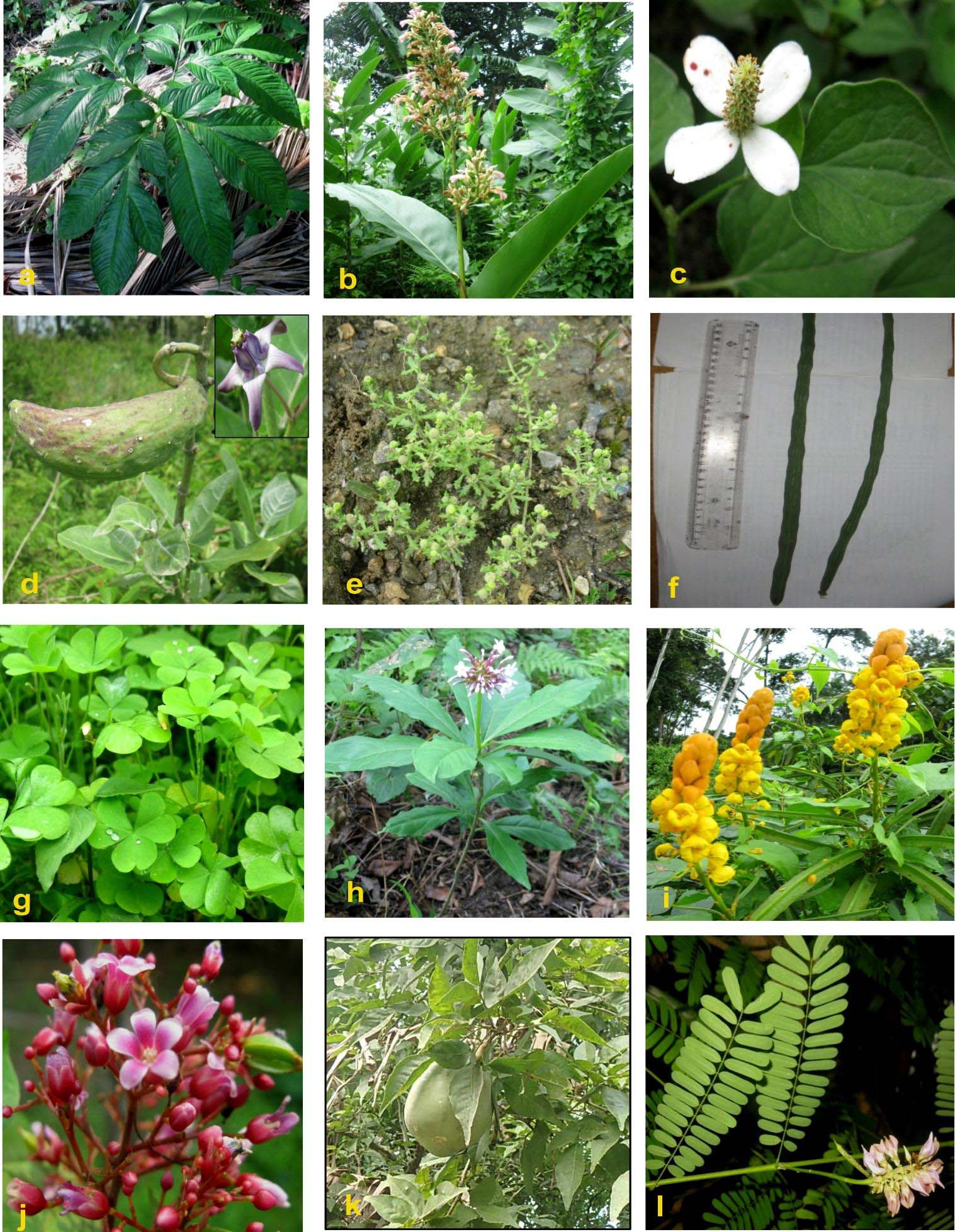
Plant species collected and used for different health problems, together with botanical name, family, habit, parts used to follow by folk uses were recorded. In the investigation, 38 plant species represented by 38 genera belong to 31 families were found to be used by the Boro tribe in traditional healthcare system (Table 1). Out of these 38 medicinal plants 34 plant species belong to Dicotyledon, 04 to Monocotyledon. The identified medicinal plants were herbs (15 species), shrubs (11 species), trees (7 species) and lianas (5 species). The plants reported by the respondents were used to cure a number of diseases including asthma, different types of fever, hepatitic diseases, skin diseases, cuts, burns, poisonous animal bite, dysentery, stomach related diseases, blood pressure, rheumatic pain, bone fracture, etc. For the effective treatment of different diseases different parts of plants such as roots/tubers, stems, barks, leaves, flowers and fruits were used. Leaves of 19 plant species, roots, rhizome, tuber and corm of 7 plant species, fruits of 5 plant species, seeds of 3 plant species, shoot and stem of 2 plant species, latex of 1 plant species and pericarp of 1 plant species were used to cure different ailments. The plant parts were prescribed in the form of paste, decoction, extract, juice, powder, vegetables, etc. All the plants are used in the treatment of 24 different diseases.
Table 1: List of Ethnomedicinal plants of Barnadi WS
| Sl. No | Name of taxa (Voucher No.) |
Habit | Part (s) collected |
Uses |
|---|---|---|---|---|
| 1 | Abrus precatorius L. Papilionaceae (TC-203) |
L | Seed | Dried seeds powder is used for dysentery |
| 2 | Abutilon indicum (L.) Sw. Malvaceae (TC-311) |
H | Leaves | Paste of leaves is used for boils and abscesses |
| 3 | Acorus calamus L.; Araceae (TC-133) |
H | Rhizome | Paste of leaves and rhizomes are used for paralysis. |
| 4 | Aegle marmelos L. Rutaceae (TC-223) |
T | Fruit | Mature fruits are used for amoebic and blood dysentery |
| 5 | Ageratum conyzoides L.; Asteraceae (TC-233) |
H | Leaves | Leaves paste is used for removing hair lice. |
| 6 | Alpinia nigra (Gaertn.) Burtt. Zingiberaceae (TC-204) |
H | Rhizome | Paste of rhizome is used for rhematic pain |
| 7 | Alternanthera sessilis (L.) R. Br. Amaranthaceae (TC-210) |
H | Leaves | Extracts of leaves are used for asthma |
| 8 | Amorphophallus bulbifer (Roxb.) Bl. Araceae (TC-215) |
H | Corm | Paste of corm is used for bone fracture and burns |
| 9 | Averrhoa carambola L. Averrhoaceae (TC-230) |
T | Fruit | Extracts of mature fruits are used for liver weakness. |
| 10 | Bacopa monnieri (L.) Pennell. Scrophulariaceae (TC-310) |
H | Leaves | Plants are consumed and also used for liver troubles. |
| 11 | Basella alba L. Basellaceae (TC-400) |
L | Leaves | Tender leaves and shoots are used for constipation |
| 12 | Blumea lacera (Burm.f.) DC. Asteraceae (TC-240) |
H | Leaves | Paste of leaves is used in cuts and wounds. |
| 13 | Calotropis gigantea (L)R.BR. Asclepiadaceae (TC-261) |
S | Leaves | Paste of mature leaves used for bone fracture. |
| 14 | Cannabis sativa L. Cannabaceae (TC-217) |
S | Seed | Seeds are used for sleeping sickness. |
| 15 | Carica papaya L. Caricaceae (TC-270) |
S | Fruit | Young fruits are used for enhancing milk production |
| 16 | Centella asiatica (L.) Urban Apiaceae (TC-241) |
H | Leaves | Extract of leaves is used for abscesses. |
| 17 | Centipeda minima (L.). A. Br. Asteraceae (TC-219) |
H | Leaves | Extract of leaves is used for sinus problems |
| 18 | Cissampelos paerira L. Menispermaceae (TC-255) |
L | Leaves | Paste of leaves is used for burns. |
| 19 | Clerodendrum serratum Spreng. Verbenaceae (TC-320) |
S | Leaves | Extract of leaves is used for asthma. |
| 20 | Cyperus rotundus L. Cyperaceae (TC-314) |
H | Tuber | Extract of tubers is used for malaria. |
| 21 | Datura stramonium L. Solanaceae (TC-341) |
S | Leaves | Extract of leaves is used for toothache. |
| 22 | Dillenia indica L. Dilleniaceae (TC-311) |
T | Seed | Mucilaginous seeds are used for dandruff problems. |
| 23 | Enhydra fluctuans Lour. Asteraceae (TC-347) |
H | Shoot | Extract of tender shoots is used for high blood pressure. |
| 24 | Euphorbia neriifolia L. Euphorbiaceae (TC-341) |
S | Leaves | Paste of leaves is used for high fever. |
| 25 | Garcinia xanthochymus Hook. f. Clusiaceae (TC-280) |
T | Pericarp | Infusion of dry pericarp is used in high pressure problem. |
| 26 | Hauttuynia cordata Thunb.; Saururaceae (TC-289) | H | Leaves | Extract of leaves is used in rheumatic pain. |
| 27 | Jatropha curcas L. Euphorbiaceae (TC-244) |
S | Latex | Latex is used in pyorrhea problem. |
| 28 | Justicia adhatoda L. Acanthaceae (TC-432) |
S | Leaves | Extract of leaves is used for asthma. |
| 29 | Leea macrophylla Roxb. Leeaceae (TC-266) |
S | Root | Paste of roots is used for bone fracture. |
| 30 | Leucas lavandulifolia Smith. Lamiaceae (TC-299) |
H | Leaves | Extract of leaves is used for asthma. |
| 31 | Moringa oleifera Lam. Moringaceae (TC-298) |
T | Root | Extract of roots is used as antidote to snake bite |
| 32 | Oxalis corniculata L. Oxalidaceae (TC-432) |
H | Leaves | Extract of leaves is used for blood dysentery |
| 33 | Paederia foetida L. Rubiaceae (TC-421) |
L | Leaves | Extract of leaves is used in liver weakness. |
| 34 | Rauvolfia serpentia (L.) Benth. ex Kurkz. Apocynaceae (TC-392) |
S | Root | Decoction of roots is used in pressure, high blood pressure. |
| 35 | Seena alata (L) Roxb. Caesalpiniaceae (TC-385) |
S | Leaves | Paste of leaves is used in scabies and skin problems. |
| 36 | Tamarindus indica L. Papilionaceae (TC-369) |
T | Fruit | Decoction of fruits is used for high blood pressure. |
| 37 | Terminalia bellirica Roxb. Combretaceae (TC-411) |
T | Fruit | Extract of fresh fruits is used in various liver problems. |
| 38 | Tinospora cordifolia (Willd.) Hook.f. & Th.; Menispermaceae (TC-291) |
L | Stem | Extract of fresh stem is used for liver weakness. |
Conclusion
The present study was documentation of 38 ethnomedicinal plants utilised by Boro tribe, living in fringe areas of Barnadi Wildlife Sanctuary, Udalguri Assam. It was found that plants used in herbal preparation are mostly collected from the wilderness. However, some expert herbal practitioners have their own small medicinal herbs garden. Kaviraj and Ojas of the tribe were totally dependent on surrounding forest resources. These practices impose threat towards the extinction of different rare and endangered plant species having various medicinal value. Urgent strategies are urgently required for conservation and large-scale cultivation of these plants involving the local tribal community participation having unique eco-cultural traditions. Scientific exploration of the chemical constituents of these medicinal plants is also required to bring this traditional inventory of knowledge in the light of modern medical science.
Declaration
Conflict of Interest: The authors declare that they have no conflict of interest.
References
- Baruah P & Sharma G.C. (1984). Studies on medicinal uses of plants by the Bodo tribals of Assam II, Journal of Economic and Taxonomic Botany 5(3):599-604.
- Chowdhury, S. (2005). Assam’s Flora (Present status of Vascular plants), Assam Science Technology and Environment Council, Guwahati, Assam.
- Jain, S.K. & Borthakur, S.K. (1980). Ethnobotany of the Mikirs of India, Economic Botany 34:264-272.
- Jain, S.K. (1987). A Manual of Ethnobotany. Scientific Publication, Jodhpur.
- Jain, S.K. & Rao, R.R. (1977). A Handbook of Field and Herbarium Methods. Today & Tomorrow's Printers Publications, New Delhi.
- Borthakur, S.K., Bawri, A., Baro, D. & Boro, A. (2018). Flora of BTAD, Assam. Vol. IV. EBH, Publishers, Guwahati.
- Boro, A. (2017). Floristic study of Udalguri District, Assam. Ph. D. Thesis, Faculty of Science, Gauhati University, Guwahati, Assam.
- Boro, A., Bhattacharjee & Sarma, G.C. (2011). Wild vegetables used by Bodo tribe in Udalguri District of Assam, India, Pleione 5(2):209-216.
- Chowdhury, S. (2005). Assam’s Flora: Present status of Vascular Plants. Assam Science Technology and Environment Council, Guwahati, Assam.
- Sarma, S.K., Bhattacharjya, D.K. & Devi, B. (2001). Medicinal plants used by Bodo Tribe of Nalbari district in Assam. Ethnobotany 13:135-139.
- Basumatary, S.K., Ahmed, M. & Deka, S.P. (2004). Some medicinal plant leaves used by Boro (tribal) people of Goalpara district, Assam. Natural Product Radiance 3(2):88-90.
- Saikia, B., Borthakur, S. K. & Saikia, N. (2010). Medico-ethnobotany of Bodo tribals in Gohpur of Sonitpur district, Assam. Indian Journal of Traditional Knowledge 9 (1):52-54.
- Talukdar, S. & Gupta, A. (2014). Medicinal plants used by the Bodo community of Chakrashila Wildlife Sanctuary, Assam, India. Indian Journal of Applied Research 4(2):1-4.
- Das, S., Nigam, A. & Sharmah R.K. (2014). Ethno-botanical Studies of Medicinal Plants used by Bodo Tribes of Baksa District, BTAD, Assam. Global Journal for Research Analysis 3(10):84-88.
- Boro, M., Das, B., Boro, K. K., Nath, M., Buragohain, P., Roy, S., Sarma, P. J., Kalita, S. & Nath N, (2023). Quantitative ethnobotany of medicinal plants used by the Bodo Community of Baksa District, Assam, India. Biodiversitas 24(6):3169-3182.
- Basumatary, J., Thungon, R.N., Hui, P.K. & Tag, H. (2025). Ethnobotany of medicinal plants used by the Bodo community living along urban localities of Kokrajhar district in BTAD region of Assam, India. Journal of Bioresources 12 (1):31-41.
- Sarkar, S.; Deka, D. & Devi, N. (2008). Studies on some medicinally important wetland angiosperms used by Boro tribe of Kamrup district in Assam, India. Pleione 2(1):20-26.
**************