

The Biotic and Abiotic Mode of Pollination in the Epiphytic Orchid
Acampe
papillosa (Lindl.) Lindl
1Bhaskar Buragohain and 2Koustuv Buragohain*
1Mariani College, Mariani, Assam, India, 785634
2Department of Life Science, Assam University, Silchar, Assam, India. 788011
*Corresponding author: bhaskar.mariani@gmail.com
Abstract
The genus Acampe consist of ten species out of which only four species found in India. The pollination biology of the orchid Acampe papillosa was conducted at their natural habitat for two consecutive years 2023 and 2024. Flowers are small and wide open vertically on a sub-umbellate inflorescence. Flowers with distinct, straight, long and round spur contains an untraceable amount of nectar on the hairy wall. The flowers are exclusively pollinated by solitary bee Lasioglossum puvonatum. Experimental hand pollination reveals that flowers are self-compatible and non-autogamous. Abiotic pollination through rain occurs in natural population (Ombrophily).
Key words: Pollination biology, Acampe papillosa. nectar, pollinator, ombrophily.
Introduction
Orchidaceae is the largest family of the Spermatophytes in the world and is represented by 29,199 species worldwide (Govaerts et al., 2017). In India the family Orchidaceae is represented by 1484 taxa (1430 Species, 8 subfamilies and 46 varieties) under 191 genera. (Misra, 2019) of which 388 species are endemic to India (Singh et al. 2019). In North-east India about 990 species belonging to 165 genera has been reported so far (L.C. De & Medhi, R.P., 2014; Rao, A.N. 2007). Out of 990 species of North East India 563 species under 85 genera are epiphytic, 298 species of 68 genera are terrestrial and 39 species of 18 genera are mycotrophs (saprophytic). Orchidaceae a very highly evolved family with their adaptability to live as epiphytes, terrestrial and saprophytic habitat and also for their speciality to perform sexual reproduction (Buragohain, 2025). The orchid flowers are extremely attracting due to their diverse floral morphology, vibrant colour patterns, fragrance. The orchids are not just valued for their aesthetic beauty but they are also prized for their inherent medicinal properties as well as commercial importance as long lasting cut flowers, source of biochemicals for medicinal and consumable purposes. Low temperature and high humidity with good rainfall and high altitudinal variation of entire North East Indian region makes this part as a hot spot for orchid population (De & Medhi, 2014).
The high diversity in Orchidaceae is probably due to the nature of highly evolved pollination mechanism and fruit set, pattern of cross pollination, capability of adaptation in varied environmental conditions, compatibility for hybridization, easy seed dispersal and the mode of effective vegetative pollination (Van der Pijl & Dodson 1966; Dressler 1981). In pollination biology of orchids, they are divided into rewarded and deceptive groups (Jersacova et al., 2006). One third of Orchid species are pollinated through deceptive pollination (Van der Pijl & Dodson 1966; Dressler, 2006; Ackerman, 1986; Tremblay et al. 2005; Renner, 2006). In the deceptive orchids the resources are not allocated for producing rewards like nectar, instead the resources are utilized for other purposes like physical fitness, floral longevity and seed production (Gijbels et al., 2015; Jersacova et al., 2006). The longevity of flowers of deceptive orchid is much higher than the rewarded orchids. The abiotic mode of pollination refers to the mechanism of pollination without the involvement of animals and it excludes the self-pollination. In almost 20% of angiospermic families pollination by wind (anemophily) and pollination by water (hydrophily) are occur (Ackerman, 2000). In several species of plants one unusual form of pollination described by Hagerup (1950) in the windswept and rainy conditions which are the characteristic in Faroe Islands. Self-pollination may be occured when the flowers remain open during rain filled with water which enabling pollen to be shifted to stigmas of the same flower. Ombrophily, a mode of abiotic pollination mediated by rain, is generally regarded as a strategy for reproductive assurance and promoting self-pollination during conditions when pollinator visits are infrequent (Stebbins, 1957; Faegri & Van der Pijl, 1979). In the biotic mode pollination system of orchids insects belongs to the order Hymenopters, Lepidoptera, Coleoptera are involved (Buragohain et al., 2016). The abiotic pollination system of orchids is an alternative of biotic pollination and the pollination success is varied. Though tremendous diversity of pollination system in Orchidaceae are found but no species has been reported that is exclusively abiotically pollinated (Tremblay et al., 2005; Fan et al., 2012).
The genus Acampe comprises of about 10 species of epiphytic or lithophytic habitat and are distributed from tropical and subtropical Africa through the Himalayan region and Indochina to South East Asia (Chen & Wood, 2009). In India A. papillosa are reported from all the North Eastern States, Andhra Pradesh, Bihar, Chhattisgarh, Jharkhand, Madhya Pradesh, Odisha, Uttarakhand, West Bengal, In India four species of the genus Acampe Viz. A. ochracea, A. papillosa, A. praemorsa and A. rigida have been reported of which A. papillosa and A. rigida are reported from all the eight North East Indian states (Rao, 2007). A. papillosa is an epiphytic orchid with small beautiful flowers arranged on sub-umbellate inflorescence. Flowers slightly fragrant, opening widely, column short, anther cap loosely attached on two golden yellow pollinia. Pollinarium consist c. 1.5mm long stipe and sticky viscidium. Stigmatic cavity narrows and elongated, rostellum small, fibrous. Spur straight, cylindrical, inside with dense white hairs and untraceable amount of nectar spread over the internal wall of spur like thin film of layers. Flowering from August to November.
Preliminary field observations of A. papillosa populations reveals that capsule formation occurs at a very low rate ±.02% in open populations and poor visit of pollinators or visitors were observed. This study was important in terms of conservation of this valuable orchid species.
Materials and Methods
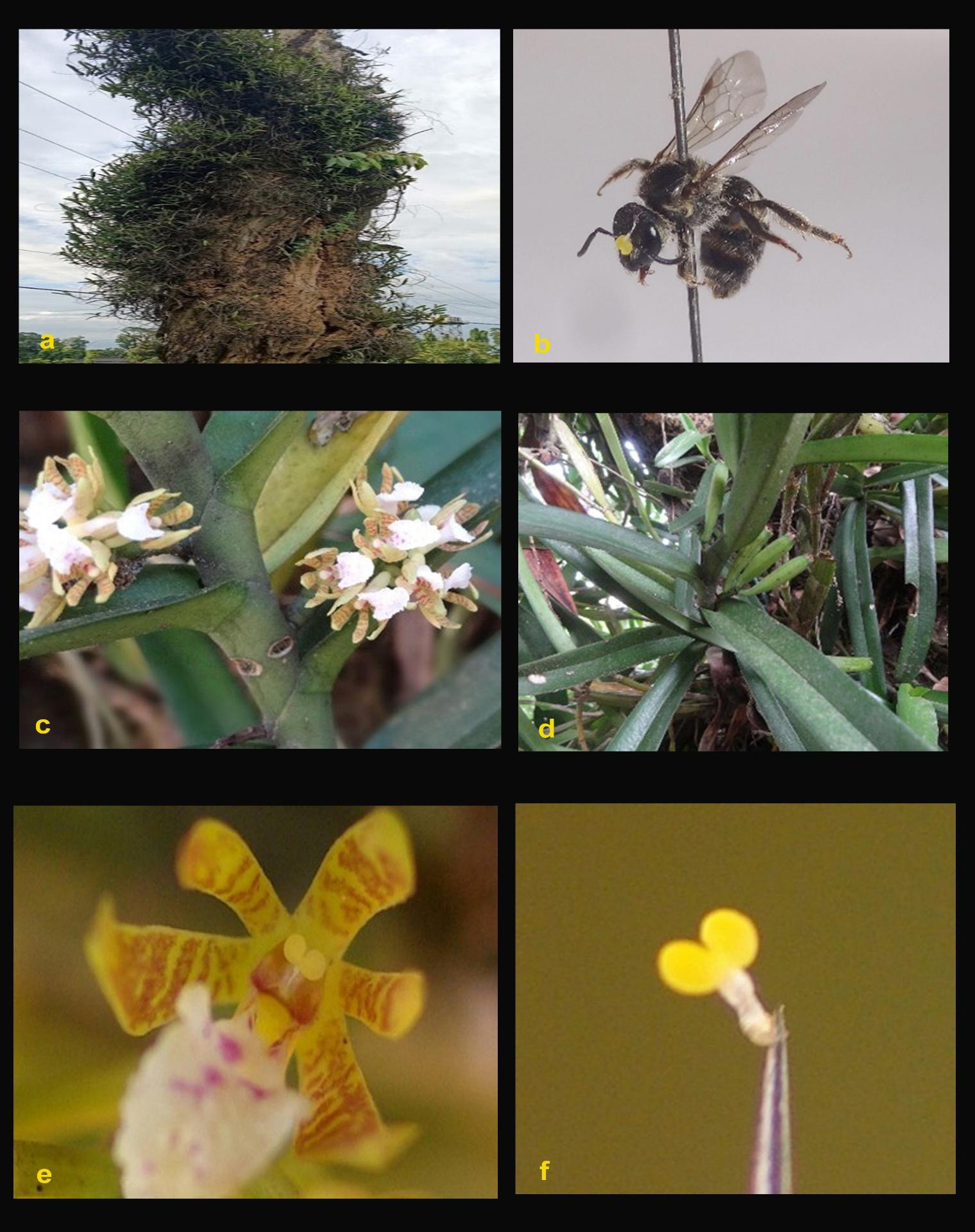
The observation of open pollination of A. papillosa were performed in the population present in Dissoi Vally Reserve Forest near the border area of Assam and Nagaland states and the area is close to Mariani Town (5 km) under Jorhat District of Assam, India (26°36'10.6'' N and 94°20'59.9''E, Alt. 170 M). A. papillosa clones are grown luxuriantly on the main trunk and branches of Lagerstroemia speciosa, Shoria robusta and Mangifera indica plants (Fig. 1a.)
To investigate rain pollination in the flowers of Acampe papillosa, the methodology described in the pollination of Acampe rigida which is a deceptive orchid was followed (Fan et al. 2012). To investigate biotic pollination in the open populations continuous observation of the inflorescence was performed for two consecutive years 2023 and 2024 during the flowering periods. As the flowers are considerably smaller in size therefore it was assumed that small insects would have successfully pollinate the flowers. Visitors carrying the pollinaria attached to their body are considered as pollinator (Buragohain et al., 2015). The observation for biotic pollination of A. papillosa were made between 7.00 am to 1.00 pm during the flowering periods of September and October in the year 2023 and 2024. The clear sunny days were preferred for observation of pollination events in their natural habitat.
Pollination Experiments
To observe the occurrence of autogamy 10 nos. of inflorescence were bagged by small nylon net bags before anthesis and bags were removed after the senescence of all the flowers. The experiments for testing the self-compatibility were performed by placing the pollinaria of a flower on its own stigma and then covered until the growth of ovary. Cross pollination experiments were performed between the flowers of the same plant to observe the result of geitonogamy as well as between the flowers of plants growing at a distance of about 4 meters so as to observe the results of xenogamy (Buragohain et al., 2016 b). The insect visitors/pollinators were captured by placing a wide mouth test tube just behind the insect while foraging the flowers and as the pollinator enters the test tube, the mouth was closed by a wash glass. The insects were killed by chloroform fumes, dried them gently and identified. Field photographs were taken with the help of Pentax Digital camera (model K 10 D) with 50 mm and 100 mm macro lens and Sony Digital Camera (Model DSC-HX 7V). Repeated observation was conducted during the periods of flowering, so as, to note the visiting behaviour of insects and to identify the pollinators as well as the mechanism of pollination in the open populations. Artificial rain pollination was also conducted in the open populations. Rain water was sprayed on the flowers artificially and the opening and removal of anther cap was studied.
Results
Rain pollination
Observation of rain drop mimicking experiments reveals that the rain drops while continuously fall on the vertically open flowers, the water pressure loosen the connectivity between the anther cap and column. Water enters in between the gaps of pollinia and anther cap finally the anther cap separates from the column exposing the pollinia at the top of the column. Two different phenomenas were observed. In 20 flowers the pollinia attached on the on the anther cavity, remain there for 2-4 days. The pollinia swells and enlarges and create pressure on each other (Fig. E). Due to the pressure one pollinia bent downwards and fixed over the stigmatic surface. Growth of the ovary starts after c. 35 hrs. of pollination. In 18 number of flowers, it has been observed that the rain drop while hitting on the anther cap, it was separated from the column exposing the pollinia. The pollinia were separated from the column but the viscidium attached above the rostellum causing the pollinia hanging from the apex of the column. The freshly separated pollinia hanged in front of the stigmatic cavity. The pollinia are mounted on the sticky stigmatic exudates and the process of self-pollination accomplished.
In the Vandeous orchid species the stipe that connect the pollinia with the viscidium is flat and stout, thus after separation from the column the stipe bent backwards lifting the pollinia upwards (Buragohain and Chaturvedi, 2016 b; Buragohain et al., 2025). In the case of A. papillosa as the stipe is filamentous it drops downwards and hanging the pollinia.
Biotic pollination
The flowers of A. papillosa are slightly fragrant, sepals and petals are fleshy, opening widely; sepals and petals yellow with reddish brown transverse stripes, labellum creamy white, slightly purple-red spotted. The small size beautiful flowers attract numbers of black ants, butterflies (Notocrypta curvifascia). The common solitary bee Lasioglossum puvonatum has been confirmed as legitimate pollinator of the orchid Acampe papillosa. L. puvonatum is a common orchid bee and are found visiting all the available orchid species of North East India. They are the most common pollinator of Dendrobium species. The pollinator bee L. puvonatum hover around the inflorescence before foraging. The pollinator landed over the labellum and positioned them vertically over the flower. While they insert the proboscis into the spur to suck nectar the occiput of the head push the rostellum, during retreating the rostellum pushed the anther-cap and the viscidium exposed which become attached on the vertex of the head, thus pollinaria separation process completed. The pollinia are hanged above the frons of the head. The pollinator carrying the pollinaria while revisit another flower in search of nectar the pollinia transferred on the sticky stigmatic exudates and pollination process thus accomplished. In biotic mode of pollination both self and cross pollination was found.
Discussion
The vertically open flowers with the centrally situated column allow the rain drops to fall over the anther cap causing the anther cap separated from the column exposing the pollinaria and self-pollination is resulted. In ombrophily or rain pollination only, the self-pollination is possible. Ombrophily is an advanced mode of self-pollination and particularly helpful where pollinators visit to the flowers are rare. In Biotic mode of pollination, the flowers are exclusively pollinated by the solitary bee Lasioglossum puvonatum. The pollinaria are attached over the vertex of the head which is also known as frontotribic mode of pollination. A. papillosa exhibited a higher rate of succesful pollination through rainfall than it did when relying on biological agents. Like the flowers of Acampe rigida, the flowers of Acampe papillosa possess floral adaptations which can facilitates the process of rain pollination or Ombrophily. The funnel shaped vertically open flowers, centrally located short and stout column with apically placed loose anther cap which is easily dislodged by direct rain drops causing exposure of pollinaria also leading to self-pollination are the traits that facilitates rain assisted pollination as well as self-pollination.
Conclusion
The study of the pollination biology of Acampe papillosa reveals that the flowers contain untraceable amount of nectar with less concentration of sugar, mildly scented, self-compatible and non-autogamous. The flowers are capable for both biotic and abiotic pollination. Biotic pollination is exclusively performed by small solitary bee Lasioglossum puvonatum. The abiotic pollination is accomplished through rain water in the form of rain drop directly fall on the anther cap which cause the removal of the anther cap and the uncovered pollinia transferred to the stigmatic cavity.
Declarations
Conflict of interest: The authors declare that they have no conflict of interest
References
- Ackerman JD. (2000). Abiotic pollen and pollination: ecological, functional, and evolutionary perspectives. Plant Systematics and Evolution 222: 167–185.
- Ackerman, J. (1986). Mechanisms and evolution of food-deceptive pollination systems in Orchids. Lindleyana 1: 108–113.
- Buragohain, B. (2025). The 3-C of North East Indian Orchids. Current Endeavours in Multidisciplinary Sciences. Unika Publication.
- Buragohain, B. and S.K. Chaturvedi, (2016b). Deceptive Pollination in an Endangered Orchid, Vanda Coerulea Griff. Ex Lindl. (Orchidaceae). The Journal of The Orchid Society of India, 30: 31-35.
- Buragohain, B., Chaturvedi, S.K. & Puro, N. (2016a). Pollination Biology of Phaius tankervilleae (Banks ex. L’ Herit) Bl. (Orchidaceae). The International Journal of Plant Reproductive Biology. 8 (1): 75–81.
- Buragohain, B., K. Buragohain and S.K. Chaturvedi, (2025). Generalized food deception of Vanda tessellata (Roxb.) Hook. ex G. Don (Orchidaceae). Pleione 19(1): 108–115.
- Buragohain, B., S.K. Chaturvedi and N. puro. (2015) “Biotic Pollination in Rhynchostylis retusa (L.) Bl. (Orchidaceae).” The International Journal of Plant Reproductive Biology, 7(1): 78-83.
- Chakraborty, O., D. K. Agrawala & A.P. Chakraborty, (2022). Concept of The Genus Acampe (Lindl.) in India. NBU Journal of Plant Sciences. 14: 49-60
- Chen SC, Wood JJ. (2009). Acampe Lindley. In: Wu ZY, Raven PH, Hong DY. eds. Flora of China, Vol. 25. Beijing & St. Louis: Science Press & Missouri Botanical Garden Press, 449 450.
- De, L.C. & Medhi, R. P. (2014). Diversity and Conservation of Rare and Endemic Orchids of North East India – A Review. Indian Journal of Hill Farming. 27(1): 138-153
- Dressler, R.L. (1981). The orchids: Natural History and Classification. Harvard University Press, Cambridge, Mass.
- Dressler, R.L. (2006). How many Orchid species? Selbyana 26(1-2): 155–158.
- Faegri K, van der Pijl L. (1979). The principles of pollination ecology. New York: Pergamon Press.
- Fan, Xu-Li, Spencer C. H. Barrett, Hua Lin, Ling-Ling Chen, Xiang Zhou & Jiang-Yun Gao, (2012). Rain pollination provides reproductive assurance in a deceptive orchid. Annals of Botany 110: 953–958.
- Gijbels, P., T. Ceulemans, W. Van Den Ende, & O. Honnay, (2015). Experimental fertilization increases amino acid content in floral nectar, fruit set and degree of selfing, in the Orchid Gymnadenia conopsea. Oecologia 179: 785–795.
- Govaerts R., Bernet P., Kratochvil K., Gerlach G., Carr G., Alrich P., Pridgeon, A.M., Pfahl, J., Campacci, M.A., Baptista, D. H., H. Tigges, Shaw, J., Cribb, P., George, A., Kreuz, K. & Wood, J.J. (2017). World Checklist of Orchidaceae. Kew, London: Royal Botanic Gardens.
- Hagerup O. (1950). Rain-pollination. Biologiske Meddelelser [Kongelige Danske Videnskabernes Selskab] 18: 1–19.
- Jersakova, J., S.D. Johnson & P. Kindlmann (2006). Mechanisms and evolution of deceptive pollination in orchids. Biological Review 81: 219.
- L.C. De & Medhi R.P. (2014). Diversity and Conservation of rare and Endemic Orchids of North east India- A Review. Indian Journal of Hill farming 27, 138-153.
- Misra, Sarat (2019). Orchids of India: A hand Book. Bishen Singh Mahendra Pal Singh, Dehradun.
- Rao, A. Nageswra (2007). Orchid Flora of North East India- An upto date analysis. Bulletin of Arunachal Forest research. 23 (1&2): 6-38.
- Renner, S.S. (2006). Rewardless flowers in the Angiosperms and the role of insect cognition in their evolution. In: Waser, N.M. & Ollerton, J. (Eds.), Plant-pollinator interactions: From specialization to generalization. University of Chicago Press, Chicago, IL, Pp. 123–144.
- Stebbins G.L. (1957). Self-fertilization and population variability in higher plants. American Naturalist 91: 337–354.
- Tremblay, R.L., Ackerman, J.D., Zimmerman, J.K. & Calvo, R.N. (2005). Variation in sexual reproduction in Orchids and its evolutionary consequences: A spasmodic journey to diversification. Biological Journal of Linnean Society. 84: 1–54
- Van der Pijl & Dodson (1966). Orchid Flowers: Their Pollination and Evolution. University of Miami Press, Coral Gables, FL 33134, USA.
*************