

Biocontrol Potential of Ageratum conyzoides L. Against Blight Disease of Bambusa
Roxb. in Assam, India
1Prandeep Chutia,2*Jitu Gogoi & 3Zakir H. Mallik
1,2&3Department of Botany, Silapathar Science College, Silapathar, Assam, India-787059
Corresponding address: gogojijitu@gmail.com
Abstract
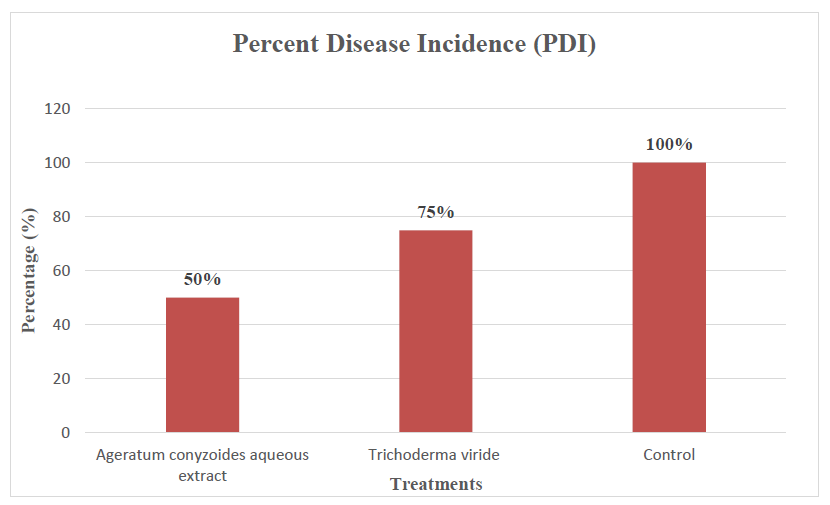
Bamboo blight, caused by Fusarium species, is a major constraint to bamboo cultivation in India. This study assessed the antifungal efficacy of aqueous leaf extract of Ageratum conyzoides against blight in Bambusa tulda seedlings under screenhouse conditions. A Completely Randomized Design with three treatments, A. conyzoides extract, a commercial Trichoderma viride formulation, and distilled water (control) as employed, each replicated four times. Inoculation with Fusarium isolates was performed using the pin-prick method and disease incidence was measured as Percent Disease Incidence (PDI). The extract reduced disease incidence to 50%, compared to 75% with T. viride and 100% in the control. These results suggest A. conyzoides as a promising eco-friendly biocontrol agent for sustainable bamboo blight management.
Keywords: Bamboo blight, Ageratum conyzoides, biocontrol, Fusarium, eco-friendly management
Introduction
Plants have long been recognized as reservoirs of bioactive compounds with antimicrobial properties. Several species produce secondary metabolites such as alkaloids, phenolics, flavonoids, and terpenoids, which are capable of suppressing the growth of pathogenic fungi and bacteria (Maity et al., 2009; Saha et al., 2005). These natural products act through diverse mechanisms, including disruption of cell membranes, inhibition of spore germination, and interference with enzymatic activity, thereby offering broad-spectrum protection against microbial invasion. The use of medicinal plants in disease management is an ancient practice that continues to attract scientific interest, particularly because plant-based extracts are cost-effective, biodegradable, and environmentally safe alternatives to synthetic agrochemicals (Dwivedi, 1998).
Bamboo, a fast-growing and economically important resource, plays a vital role in rural livelihoods, construction, handicrafts, and ecological restoration. Among the bamboos, Bambusa tulda, B. balcooa, and B. nutans are the most commercially important species in India. However, the productivity of these species is constrained by various diseases. Blight and rot are particularly destructive, affecting bamboo seedlings as well as plants at premature stages. Blight diseases severely limit bamboo growth and survival, impacting several species including Bambusa bambos, B. balcooa, B. tulda, and B. vulgaris (Gibson, 1975; Rahman, 1978; Boa, 1987). In India, blight outbreaks have been frequently reported, with Fusarium semitectum, F. udum, F. oxysporum, and Sarocladium oryzae identified as major causal agents in B. balcooa, B. nutans, B. tulda, and B. pallida across Odisha, Nagaland, and Assam (Gupta et al., 1990; Jamaluddin et al., 1992; Borah et al., 2011; Gogoi et al., 2013; Gogoi et al., 2015). The humid climate and frequent waterlogging in Assam further predispose bamboo stands to various disease including blight and rot diseases (Gogoi et al., 2010). These pathogens not only reduce seedling survival and growth but also threaten large-scale bamboo cultivation programs aimed at meeting industrial and ecological demands. Conventional management strategies rely heavily on chemical fungicides, which, while effective, raise concerns about environmental contamination, pathogen resistance, and adverse impacts on non-target organisms.
In this context, biocontrol approaches using plant-derived extracts and microbial antagonists have emerged as promising alternatives. Among medicinal plants, Ageratum conyzoides has attracted attention due to its rich phytochemical profile and reported antimicrobial activity. Extracts of A. conyzoides have been shown to inhibit several plant pathogens, suggesting its potential role in sustainable crop protection. The present study was therefore undertaken to evaluate the antifungal efficacy of aqueous leaf extract of A. conyzoides against bamboo blight in Bambusa tulda seedlings caused by Fusarium species. By comparing its performance with a commercial Trichoderma viride formulation under controlled conditions, this work aims to establish the relevance of A. conyzoides as an eco-friendly biocontrol agent for bamboo disease management.
Materials and Methods
The study was conducted at the Rain Forest Research Institute, Indian Council of Forestry Research and Education, Jorhat, Assam, India (26.728291° N, 94.292766° E) between January and October 2025. The seedlings of the Bambusa tulda were obtained from the ICFRE-Rain Forest Research Institute, Jorhat, Assam (ICFRE- RFRI) nursery and maintained in pots until inoculation.
Pathogen inoculation
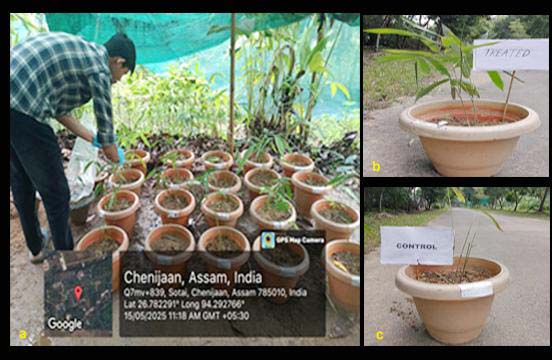
Fusarium isolates cultured on potato dextrose agar (PDA) were used to inoculate seedlings via the pin-prick method. Inoculated plants were covered with moist polyethylene bags to promote disease development (Plate -1)
Preparation of extract
Fresh leaves of Ageratum conyzoides collected from the ICFRE- RFRI, Botanical Garden were washed, air-dried, and ground. A 30% (w/v) aqueous extract was prepared (30 g leaf/100 ml distilled water), filtered and used for treatments.
Experimental design
A Completely Randomized Design (CRD) with three treatments—(T1) A. conyzoides extract, (T2) commercial Trichoderma viride, and (T3) distilled water (control)—was employed, each with four replications.
Data collection and analysis
Disease incidence was recorded as Percent Disease Incidence (PDI) using the formula:
PDI(%) = n / N × 100
where n = infected plants and N = total plants assessed. Data were analyzed under CRD using ANOVA after angular transformation.
Results and Discussion
Application of A. conyzoides extract resulted in a PDI of 50%, whereas T. viride treatment recorded 75% PDI. The untreated control showed complete disease incidence (100%). These results confirm that A. conyzoides extract is more effective in reducing bamboo blight incidence compared to T. viride. (Plate -2 & Plate -3) Previous studies have documented antifungal properties of A. conyzoides extracts against Fusarium species. Leaf extracts in aqueous, methanolic, and n-hexane forms have demonstrated significant inhibitory effects on Fusarium solani growth (Javed et al., 2012). Active compounds such as precocene II and nobiletin have been reported to possess antifungal potential against Fusarium oxysporum and Fusarium solani. The findings of this study align with earlier research and emphasize the potential of A. conyzoides as a natural, eco-friendly substitute for chemical fungicides (Table -1 & Fig-1). Further investigations are recommended to optimize dosage, formulation, and field-level applications of A. conyzoides extract. Additionally, combining it with other biocontrol agents may enhance its effectiveness and sustainability in bamboo disease management.
Table.1: Disease incidence after treatment
| Sl. No. | Treatments | Percent Disease Incidence (PDI) |
|---|---|---|
| 1 |
T1: Ageratum conyzoides aqueous leaf extract |
50.00 (45.00) |
| 2 |
T2: Trichoderma viride commercial product-AAU Bio-green |
75.00 (60.00) |
| 3 | T3: Control |
100.00 (90.00) |
(Figures in the parenthesis are the angular-transformed values)
Conclusion
The present study confirms that aqueous leaf extract of Ageratum conyzoides exhibits significant antifungal activity against Fusarium-induced blight in Bambusa tulda. Under screenhouse conditions, the extract effectively reduced disease incidence, performing better than the commercial Trichoderma viride formulation. These findings highlight the potential of A. conyzoides as a cost-effective and eco-friendly biocontrol agent for bamboo disease management. Utilizing locally available plant resources offers a sustainable approach that reduces reliance on synthetic fungicides and promotes environmentally sound cultivation practices. Future research focusing on field-scale validation and phytochemical characterization of the active constituents will be essential to establish its role in integrated bamboo health management across Assam and other bamboo-growing regions of India.
Acknowledgement
I sincerely thank the Director, Rain Forest Research Institute (RFRI), Jorhat, Assam, for providing facilities to conduct this research. My deep gratitude goes to Dr. Rajib K. Borah, Scientist, RFRI, for his guidance as external supervisor. I also acknowledge the all-faculty members of the Postgraduate Department of Botany, Silapathar Science College, for their support in completing this six-month M.Sc. Botany project under Assam Science and Technology University.
Declaration
Conflict of Interest: The authors declare that they have no conflict of interest.
References
- Borah, R. K., Dutta, D., & Hazarika, P. (2011). A preliminary study on the occurrence of blight disease in Bambusa tulda Roxb. In Productivity enhancement and value addition of bamboos, pp. 80–83. Institute of Forest Productivity.
- Boa, E. R. (1987). Bamboo blight and the bamboos of Bangladesh. Forest Products Bulletin, 1, 43.
- Gibson, G. S. (1975). Bamboo blight and the bamboos of Bangladesh. Forest Products Bulletin, 1, 43.
- Gogoi, J., Teron, R., & Tamuli, A. K. (2013). Incidence of blight and rot diseases of Bambusa tulda Roxb. groves in Dimapur district of Nagaland. International Journal of Science and Nature, 4, 478–482.
- Gogoi J., Teron R. &Tamuli K. (2015): Blight disease of Bambusa balcooa Roxb.: A potential threat to village bamboo groves of Dimapur District in Nagaland State. Dimorian Review E-Magazine ( http://www.dimorianreview.com/vol.-2., issue-5, pp. 8-15 ).
- Gogoi J., Borah R. K, & Lahan, J.P. (2010). A study on certain bamboo diseases in Dhemaji District, Assam. Nature and Environment, volume 2-3, Pp. 50-53.
- Gupta, R. K., Jamaluddin, S., & Tewari, D. N. (1990). Bamboo blight in India. Indian Forester, 116(3), 211–213.
- Jamaluddin, S., Tewari, D. N., & Sharma, R. (1992). Bamboo blight in India. Indian Forester, 118(3), 211–213.
- Javed, S., & Bashir, U. (2012). Antifungal activity of different extracts of Ageratum conyzoides for the management of Fusarium solani.
- Maity, P., Hansda, D., Bandyopadhyay, U., & Mishra, D. K. (2009). Biological activities of crude extracts and chemical constituents of Aegle marmelos. Indian Journal of Experimental Biology, 47, 849–861.
- Rahman, M. A. (1978). Bamboo blight and the bamboos of Bangladesh. Forest Products Bulletin, 1, 43.
- Saha, S., Chant, D., Welham, J., & McGrath, J. (2005). A systematic review of the prevalence of schizophrenia. PLoS Medicine, 2(5), 141.