
Patterns of Diversity, Abundance and Species Richness of Butterfly Fauna in
Borajan-Bherjan-Podumani Wildlife Sanctuary, Assam
1Nikita Das*
Department of Zoology, Sikkim Central University, Gangtok, Sikkim, India
*Corresponding author: nitunikita1903@gmail.com
Abstract
Butterflies are important pollinators and effective bioindicator species to assess habitat quality and environmental health. The present study, conducted from March to October 2024, documents the diversity, species richness, and abundance of butterflies in the Borajan -Bherjan- Podumani Wildlife Sanctuary, Tinsukia District, Assam. A total of 89 butterfly species belonging to six families were recorded, out of which 14 species are protected under various schedules of the Indian Wildlife (Protection) Act, 1972. Out of the six families, the Nymphalidae family was the most dominant with 43 species, followed by Pieridae (13), Lycaenidae and Hesperidae (12 each), Papillionidae (8) and Riodinidae (1). The highest Shannon–Wiener Diversity Index (H′=3.63) and Evenness (E=0.96) were of the Nymphalidae family, which has the maximum diversity index of 3.63 and Evenness (E) is 0.96 for the family Nymphalidae. The study area highlights that the sanctuary has a rich butterfly diversity and important habitat for butterflies, emphasising the need for more conservation-focused studies and robust management strategies.
Key words: Lepidoptera diversity; Conservation; Wildlife Sanctuary; Shannon-Weiner index
Introduction
Butterflies, an important pollinator in an ecosystem beyond their aesthetic values they play an important role in ecosystem functioning, particularly as a biodiversity indicator species [1], [2]. Their high sensitivity to any subtle changes in environmental gradients and habitat heterogeneity strongly influences their species composition in a particular area, making them reliable indicators of habitat quality [3], [4].
Butterflies are considered to be one of the best taxonomically studied and documented groups of insects [5]. The members of the order Lepidoptera are distinguished from their other insect relatives by the presence of minute scales covering their wings and a pair of clubbed shaped antenna. The diversity of this insect fauna is restricted to specific habitats as butterflies, and their caterpillars are contingent on specific host plants and food resources [6].
Lepidoptera is further divided into Rhopalocera and Heterocera and into two groups, namely Microlepidoptera and Macrolepidoptera. Microlepidoptera consists of small moths, whereas Macrolepidoptera consists of all large moths and butterflies. The two superfamilies of the order Lepidoptera are Hesperioidea and Papilionoidea [7] where Hesperioidea includes skippers, and Papilionoidea comprises the true butterflies. Superfamily Papilionoidae is divided into five families Papilionidae (Swallowtails), Pieridae (Whites and Yellows), Lycaenidae (Blues), Riodinidae (Judies and Punches), and Nymphalidae (Brush-footed butterflies) [8].
Butterflies are the ideal organisms for various ecological studies, and the loss of abundance and diversity adversely impacts the ecosystem functioning of an area [6]. The North-Eastern region of India is home to a rich butterfly diversity [9]. Assam, located in this biodiverse region of North East India, lies between the Eastern Himalayas and the Indo-Burmese hotspot. The state supports a vast array of species, yet deforestation and resource exploitation are gradually decreasing its diversity of flora and fauna [10].
The documentation of butterflies in the state of Assam goes back to the British Era. In the Eastern Himalayan region, the major account of butterflies was documented by Evans [11], who documented 96 endemic butterfly species, of which 45 species were from Assam. Similarly, Talukder and De [12] conducted comparative research on the diversity of butterflies in tropical semi-evergreen forest and disturbed habitats in Assam University Campus, Silchar, Assam. Another preliminary study carried out by Gogoi [13] documents 292 butterfly species from Jeypore-Dehing Forest, indicating high butterfly diversity in the semi-evergreen forest of upper Assam. Similar findings with abundance of swallowtail butterflies population in Dangori reserve forest in Tinsukia District of Assam also indicate high butterfly diversity in the region [14].
The Borajan-Bherjan-Podumani Wildlife sanctuary of Tinsukia district, Assam, is less explored in terms of studies on butterfly diversity, hence this present study was undertaken to document the diversity, abundance and species richness of butterfly fauna in this protected area with reference to their conservation status.
While many studies have documented diversity and identified many endemic species of the butterfly fauna in the Eastern Assam’s protected sites, yet many other protected areas, mainly on the easternmost part of the state, such as the Borajan-Bherjan-podumani Wildlife Sanctuary has not been completely documented. There is a need for proper documentation and regular monitoring of butterfly fauna from this wildlife Sanctuary which enables the reduction of human mismanagement and anthropogenic activities [15].
While studies on butterfly diversity have been documented in different habitats across the state of Assam, such as semi- urban habitats [16] and urban-altered forest habitats [17]. However, forest fragments such as Borajan-Bherjan Podumani Wildlife Sanctuary in Tinsukia district, Assam, remain less explored. Hence, the present study was undertaken to document the diversity, abundance and species richness of butterfly fauna in this protected area with reference to their conservation status.
Material and Method
Study Area
The sampling was carried out in Borajan-Bherjan-Podumani Wildlife Sanctuary in Tinsukia district, a legally protected area covering 7.22 sq. km comprising three separate forest blocks, namely Borajan, Bherjan and Podumani in Tinsukia district [18]. This sanctuary is situated in the upper Brahmaputra valley between latitudes 27°31′30.89″N and longitudes 95°22′0.53″E and falls within a humid subtropical zone supporting diverse vegetation [19].
Despite its size, the sanctuary harbours a high biodiversity, including primates such as the western Hoolock gibbon (Hoolock hoolock) and Rhesus macaque (Macaca mulatta). The wildlife sanctuary also harbors ideal habitat for mammals, including Leopard (Panthera pardus), wild boar (Sus scrofa), as well as an avian community of more than 80 species, including woodland bird species such as kingfishers, hornbill, drongos, mynas and many other insect species, including butterflies, damselflies and dragonflies [20].
Sampling Method
Butterfly sampling was conducted from March to October 2024, twice per month following the Pollard Walk Method [21]. A transect of 1 km was established within the study site and is divided into 20 smaller sections, each 50 meters in length, across different locations in the study site. Each transect was surveyed by slowly walking at a constant pace within a fixed distance, and species from either side of the transect were recorded. Identification was done by sampling and by using the photographic guide provided in Kehimkar [8], and Evans [11], and photographs were captured in cases where the identification of the small species belonging to the Hesperidae family was not feasible, and were identified later using various resources, including ifoundbutterflies.org [22].
Data Analysis
Various community parameters such as species richness, abundance, Shannon-Weiner diversity index and evenness were calculated for the butterfly community of the study area. Species richness is the total number of species recorded in the study site during the sampling. Species richness is the basic and most commonly used measure of diversity calculation of any biological community. But there is a possibility of missing many species present in an area or habitat during the sampling. Hence, different non-parametric richness estimators were computed using the software Estimate S Version 9 [23]. Among the various non-parametric estimators Chao and Jackknife estimators based on their precision in estimating true richness were considered. Based on the observed and the estimated non-parametric estimators, the species accumulation curve was obtained to test whether the sampling effort was enough to encounter all the species that occur in the study area.
The diversity was calculated using the Shannon-Weiner diversity index [24] (H′) formula: H′ = − Σ Pi ln (Pi). Where, Pi = Proportion of total sample belonging to the ith species. Similarly, evenness (E or J) was calculated by using Pielou’s Evenness index [25] formula: J = H′ / Hmax or J = H′ / ln S, where H′ is the value of the Shannon-Weiner diversity, and lnS is the natural logarithm of the species richness.
Results
During this study, a total of 89 species of butterflies of 2,211 individuals of butterfly species belonging to six families were recorded after the completion of 20 transect counts. The species accumulation curve of butterflies in the habitat is presented based on the observed and estimated richness (Table 2). The species accumulation curve reached an asymptote, indicating that the sampling effort was complete and no further sampling is required (Fig. 1).
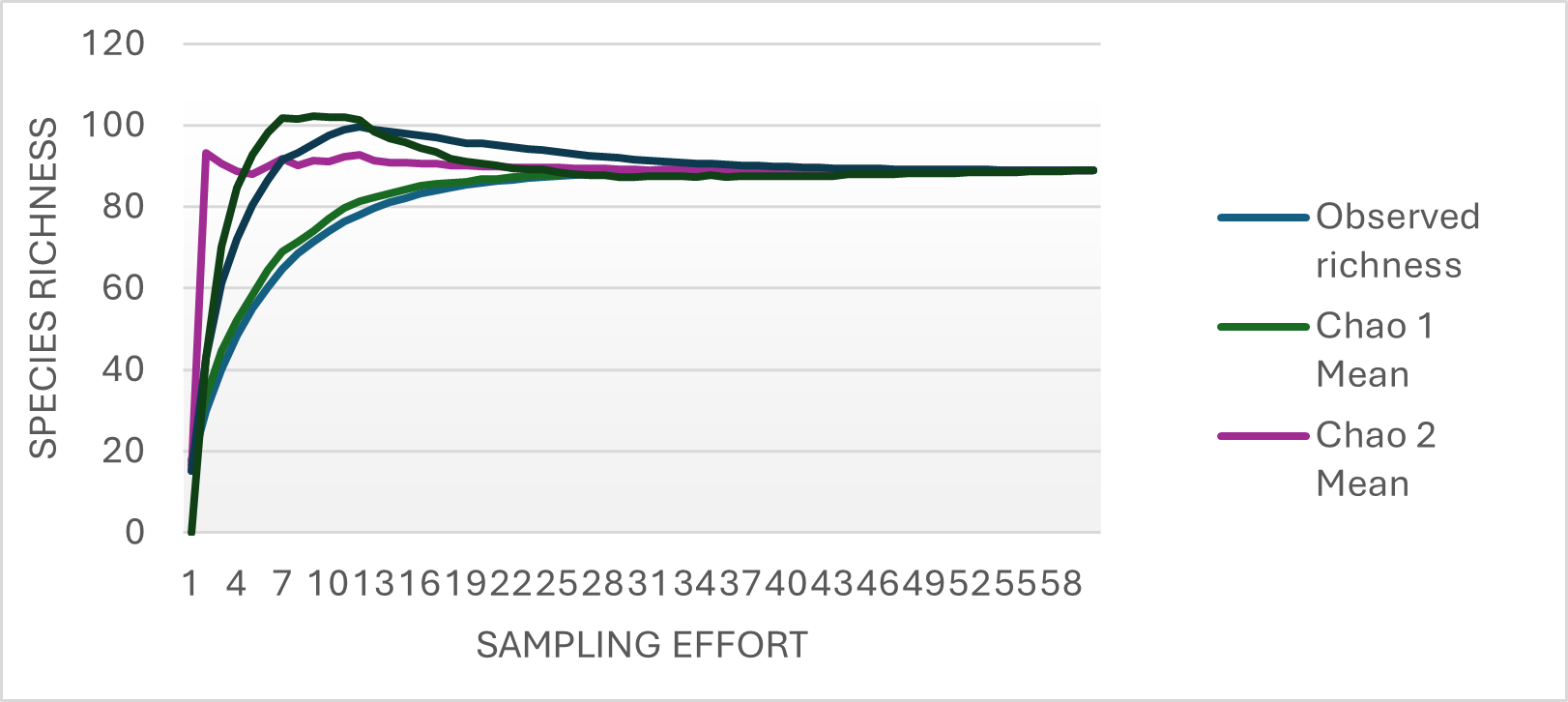
Fig. 1: Species accumulation curve of butterflies in Borajan-Bherjan-Podumani Wildlife Sanctuary, in Tinsukia District, Assam, based on observed butterfly richness and non- parametric species estimators.
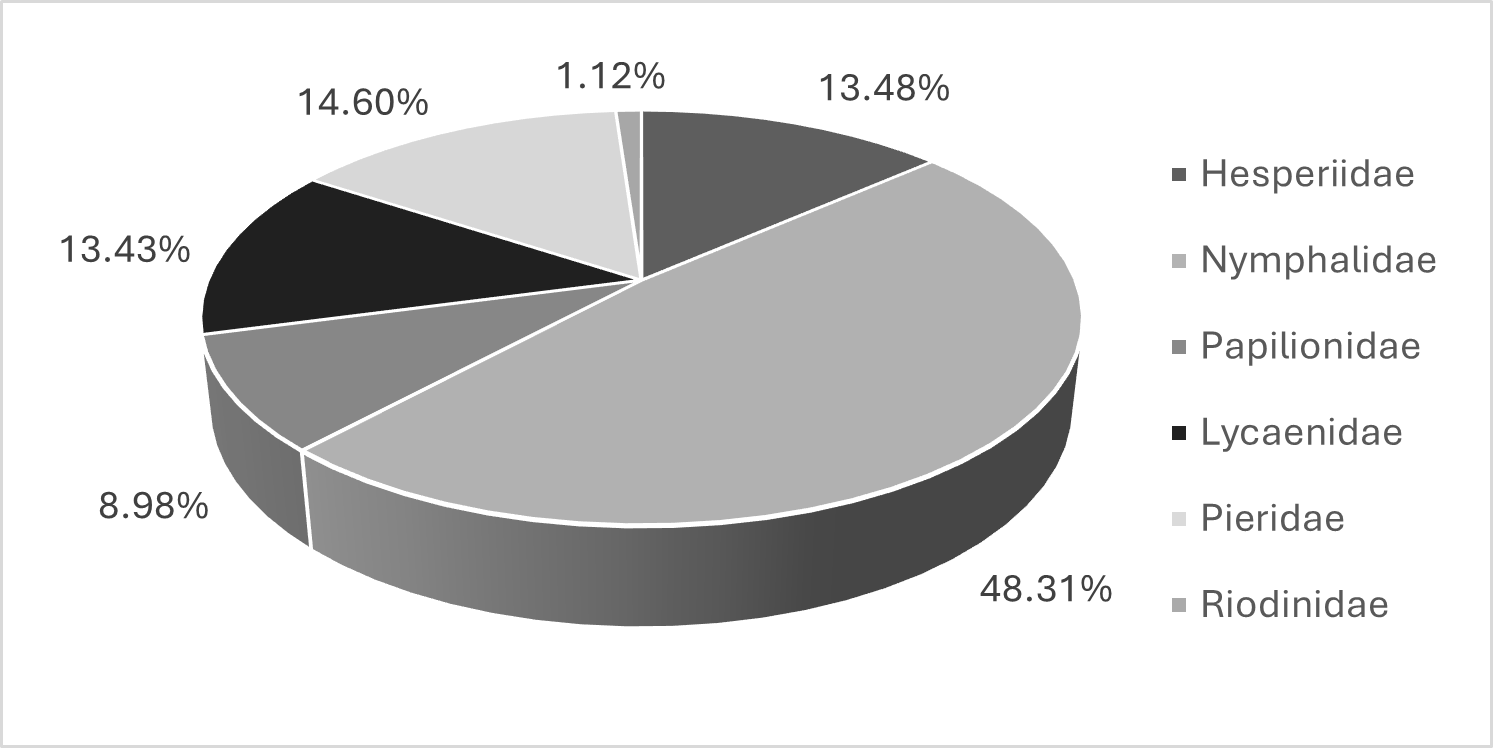
Fig 2.: Percentage occurrence of butterfly species belonging to six families
Butterflies belonging to six families, namely, Nymphalidae, Hesperidae, Papillionidae, Lycaenidae, Pieridae and Riodinidae (Fig. 4). Family Nymphalidae (48.31%) was the most dominant family with 43 species and 1,071 individuals, Pieridae (14.60%) with 380 individuals of 12 species; Lycaenidae (13.43%) with 295 individuals of 12 species, Hesperidae (13.48%) with 226 individuals of 12 species, Papillionidae (8.98%) with 213 individuals of eight species and family Riodinidae (1.12%) with 26 individuals of only one species (Table 3), (Fig. 2, Fig. 4 and Fig. 5).
The Shannon-Weiner diversity indices for the six families Hesperidae, Lycaenidae, Nymphalidae, Papillionidae, Pieridae and Riodinidae are 2.376737, 2.425171,3.639842, 2.042251, 2.50783 and 0, respectively. Similarly, Pileous evenness indices for these families are found between 0.95-0.97, indicating a good ecosystem condition (Table 1), (Fig. 3).
Table 1: Species richness in terms of number of species, abundance, Shannon-Weiner diversity index and Pielou’s Evenness of butterfly fauna in Borajan- Bherjan-Podumani Wildlife Sanctuary
| Sl. No. | Family | Number of Species | Abundances | Shanon- Weiner Diversity Index (H′) | Pielou’s Evenness Index (E) |
|---|---|---|---|---|---|
| 1 | Hesperidae | 12 | 226 | 2.37 | 0.95 |
| 2 | Lycaenidae | 12 | 295 | 2.42 | 0.97 |
| 3 | Nymphalidae | 43 | 1071 | 3.63 | 0.96 |
| 4 | Papillionidae | 8 | 213 | 2.04 | 0.98 |
| 5 | Pieridae | 13 | 380 | 2.5 | 0.97 |
| 6 | Riodinidae | 1 | 26 | 0 | 0 |
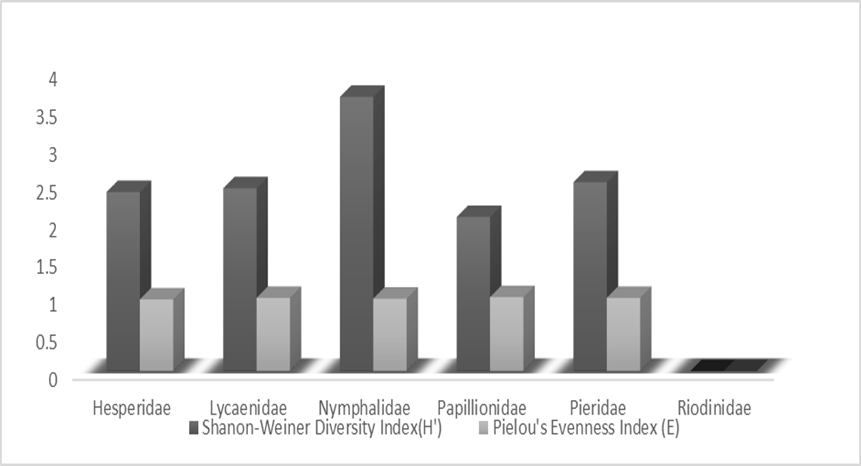
Fig. 3: Shannon-Weiner diversity index and Evenness observed for the butterfly species observed in the study area
During this study, 14 species among the total 89 species, viz. Pelopidas sinensis (Mabille) Schedule IV, Tagiades japetus (Stoll) Schedule II, Polytremis lubricans (Herrich-Schaffer) Schedule IV, Prosota aluta (Druce) Schedule II, Poritia hewitsoni (Moore) Schedule II, Prosotas nora (C. Felder) Schedule II, Lampides boeticus (Linnaeus) Schedule II, Athyma ranga (Moore) Schedule II, Discohora sondaica (Boisduval) Schedule I, Lexias dirtea (Fabricius) Schedule II, Lexias cyanipardus (Butler) Schedule II, Cynitia lepidea (Butler) Schedule II, Euploea radamanthus (Fabricius) Schedule IV, and Charaxes bernardus (Fabricius) Schedule II were found to be protected under different schedules of the Wildlife (Protection) Act, 1972 (Table 2 ).
Table 2: Butterfly species protected under different Schedules of Indian Wildlife (Protection) Act, 1972
| SL No. | Scientific name | Family | CITES | Abundance |
|---|---|---|---|---|
| 1 | Athyma ranga (Moore) | Nymphalidae | Schedule II | 16 |
| 2 | Charaxes bernardus (Fabricius) | Nymphalidae | Schedule II | 12 |
| 3 | Cynitia lepidea (Butler) | Nymphalidae | Schedule II | 27 |
| 4 | Discohora sondaica (Boisduval) | Nymphalidae | Schedule I | 1 |
| 5 | Euploea radamanthus (Fabricius) | Nymphalidae | Schedule IV | 16 |
| 6 | Lampides boeticus (Linnaeus) | Lycaenidae | Schedule II | 13 |
| 7 | Lexias dirtea (Fabricius) | Nymphalidae | Schedule II | 12 |
| 8 | Lexias cyanipardus (Butler) | Nymphalidae | Schedule II | 19 |
| 9 | Pelopidas sinensis (Mabille) | Hesperiidae | Schedule IV | 24 |
| 10 | Tagiades japetus (Stoll) | Hesperiidae | Schedule II | 36 |
| 11 | Polytremis lubricans (Herrich-Schaffer) | Hesperiidae | Schedule IV | 11 |
| 12 | Poritia hewitsoni (Moore) | Lycaenidae | Schedule II | 51 |
| 13 | Prosota aluta (Druce) | Lycaenidae | Schedule II | 24 |
| 14 | Prosotas nora nora (C. Felder) | Lycaenidae | Schedule II | 20 |
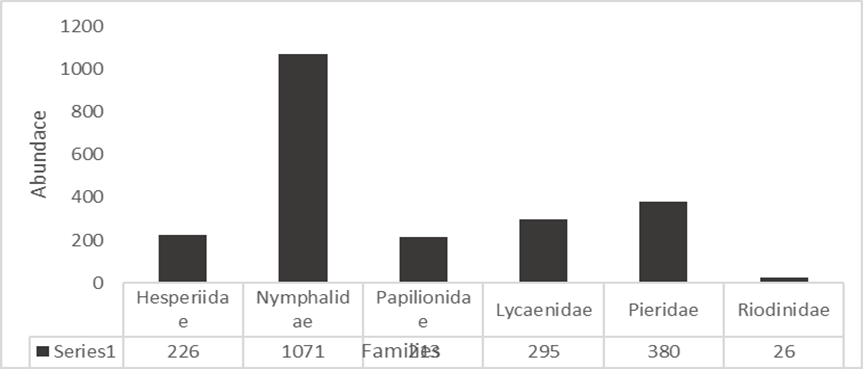
Fig. 4: Family-wise species abundance of butterfly species
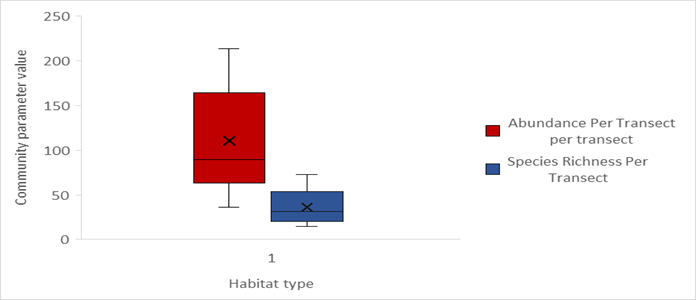
Fig. 5: Abundance and Species richness of butterfly species per transect in the study area
Table 3: List of butterfly species along with the number of individuals observed during the sampling
| SL No. | Common Name | Scientific Name | Family | Abundance |
|---|---|---|---|---|
| 1. | Angled red forester | Lethe chandica (Moore) | Nymphalidae | 31 |
| 2. | Apefly | Spalgis epius (Westwood) | Lycaenidae | 21 |
| 3. | Assam tree yellow | Gandaca harina (Horsfield) | Pieridae | 16 |
| 4. | Banded Lineblue | Prosota aluta (Druce) | Lycaenidae | 24 |
| 5. | Blackvein Sergeant | Athyma ranga (Moore) | Nymphalidae | 16 |
| 6. | Blue Admiral | Kaniska canace (Linnaeus) | Nymphalidae | 8 |
| 7. | Blue imperial | Ticherra acte (Moore) | Lycaenidae | 19 |
| 8. | Blue Tiger | Tirumala limniace leopardus (Cramer) | Nymphalidae | 35 |
| 9. | Brown pied flat | Coladenia agni (de Nicéville ) | Hesperiidae | 19 |
| 10. | Chinese swift | Pelopidas sinensis (Mabille) | Hesperiidae | 24 |
| 11. | Chocolate albatross | Appias lyncida (Crmer) | Pieridae | 51 |
| 12. | Chocolate demon | Ancistroides nigrita (Latreille) | Hesperiidae | 33 |
| 13. | Chocolate pansy | Junonia iphita (Cramer) | Nymphalidae | 36 |
| 14. | Colon Swift | Caltoris cahira (Moore) | Hesperiidae | 15 |
| 15. | Colour sergeant | Athyma nefte inara (Westwood) | Nymphalidae | 23 |
| 16. | Commander | Moduza procris (Cramer) | Nymphalidae | 18 |
| 17. | Common baron | Euthalia aconthea (Cramer) | Nymphalidae | 23 |
| 18. | Common birdwing | Troides helena (Linnaeus) | Papillionidae | 13 |
| 19. | Common bluebottle | Graphium sarpedon (Linnaeus) | Papillionidae | 36 |
| 20. | Common bushbrown | Mycalesis perseus (Fabricius) | Nymphalidae | 28 |
| 21. | Common Castor | Ariadne merione (Cramer) | Nymphalidae | 20 |
| 22. | Common crow | Euploea core (Cramer) | Nymphalidae | 31 |
| 23. | Common duffer | Discohora sondaica (Boisduval) | Nymphalidae | 1 |
| 24. | Common earl | Tanaecia julii (Lesson) | Nymphalidae | 16 |
| 25. | Common evening brown | Melanitis leda (Linnaeus) | Nymphalidae | 24 |
| 26. | Common Five-ring | Ypthima baldus (Fabricius) | Nymphalidae | 21 |
| 27. | Common four-ring | Ypthima huebneri (Kriby) | Nymphalidae | 24 |
| 28. | Common gem | Poritia hewitsoni (Moore) | Lycaenidae | 51 |
| 29. | Common Grass Yellow | Eurema hecabe (Linnaeus) | Pieridae | 34 |
| 30. | Common Lineblue | Prosotas nora nora (C. Felder) | Lycaenidae | 20 |
| 31. | Common leopard | Phalanta phalantha (Drury) | Nymphalidae | 34 |
| 32. | Common mormon | Papilio polytes (Linnaeus) | Papillionidae | 35 |
| 33. | Common Pierrot | Castalius rosimon rosimon (Fabricius) | Lycaenidae | 31 |
| 34. | Common palmfly | Elymnias hypermnestra undularis (Drury) | Nymphalidae | 49 |
| 35. | Common Rose | Pachliopta aristolochiae (Fabricius) | Papillionidae | 28 |
| 36. | Common Sailer | Neptis hylas (Linnaeus) | Nymphalidae | 14 |
| 37. | Common snow flat | Tagiades japetus (Stoll) | Hesperiidae | 36 |
| 38. | Contiguous swift | Polytremis lubricans (Herrich-Schaffer) | Hesperiidae | 11 |
| 39. | Dark archduke | Lexias dirtea (Fabricius) | Nymphalidae | 12 |
| 40. | Dark-branded Bushbrown | Mycalesis mineus (Linnaeus) | Nymphalidae | 45 |
| 41. | Dark Evening brown | Melanitis phedima varaha (Moore) | Nymphalidae | 40 |
| 42. | Dark velvet | Koruthaialos butleri (deNicéville) | Hesperiidae | 23 |
| 43. | Forget me not | Catochrysops strabo (Fabricius) | Lycaenidae | 22 |
| 44. | Glassy tiger | Parantica aglea (Stoll) | Nymphalidae | 55 |
| 45. | Great archduke | Lexias cyanipardus (Butler) | Nymphalidae | 19 |
| 46. | Great eggfly | Hypolimnas bolina (Linnaeus) | Nymphalidae | 34 |
| 47. | Great mormon | Papilio memnon (Linnaeus) | Papillionidae | 30 |
| 48. | Grey count | Cynitia lepidea (Butler) | Nymphalidae | 27 |
| 49. | Great Orange tip | Hebomoia glaucippe (Linnaeus) | Pieridae | 31 |
| 50. | Grey pansy | Junonia atlites (Linnaeus) | Nymphalidae | 26 |
| 51. | Himalyan vagrant | Vagrans sinha (Kollar) | Nymphalidae | 24 |
| 52. | Hooked awlking | Choaspes furcata (Evans) | Hesperiidae | 21 |
| 53. | Indian Cabbage White | Pieris canidia (Linnaeus) | Pieridae | 31 |
| 54. | Indian nawab | Polyura agraria (Swinhoe) | Nymphalidae | 31 |
| 55. | Indian purple sapphire | Heliophorus indicus (Fruhstorfer) | Lycaenidae | 23 |
| 56. | Large Branded Swift | Pelopidas sinensis (Mabille) | Hesperiidae | 8 |
| 57. | Lemon emigrant | Catopsilia pomona (Fabricius) | Pieridae | 19 |
| 58. | Lemon pansy | Junonia lemonias (Linnaeus) | Nymphalidae | 46 |
| 59. | Lesser Grass Blue | Zizina otis (Fabricius) | Lycaenidae | 18 |
| 60. | Large Yeoman | Cirrochroa orisa (Doubleday) | Nymphalidae | 28 |
| 61. | Leopard lacewing | Cethosia cyane (Drury) | Nymphalidae | 27 |
| 62. | Knight | Lebadea martha (Fabricius) | Nymphalidae | 9 |
| 63. | Magpie crow | Euploea radamanthus (Fabricius) | Nymphalidae | 16 |
| 64. | Map Butterfly | Cyrestis thyodamas (Boisduval) | Nymphalidae | 26 |
| 65. | One-Spot Grass Yellow | Eurema andersonii (Moore) | Pieridae | 24 |
| 66. | Painted lady | Vanessa cardui (Linnaeus) | Nymphalidae | 30 |
| 67. | Paris peacock | Papilio paris paris (Linnaeus) | Papillionidae | 23 |
| 68. | Pea blue | Lampides boeticus (Linnaeus) | Lycaenidae | 13 |
| 69. | Peacock pansy | Junonia almana (Linnaeus) | Nymphalidae | 23 |
| 70. | Plain tiger | Danaus chrysippus (Linnaeus) | Nymphalidae | 26 |
| 71. | Plain puffin | Appias indra (Moore) | Pieridae | 26 |
| 72. | Psyche | Leptosia nina (Fabricius) | Pieridae | 16 |
| 73. | Punchinello | Zemeros flegyas (Cramer) | Riodinidae | 26 |
| 74. | Red Pierrot | Talicada nyseus (Guerin-Meneville) | Lycaenidae | 26 |
| 75. | Red-lace Jezabel | Delias pasithoe (Linnaeus) | Pieridae | 24 |
| 76. | Red-spot Jezabel | Delias descombesi (Boisduval) | Pieridae | 28 |
| 77. | Rustic | Cupha erymanthis (Drury) | Nymphalidae | 1 |
| 78. | Spotted palnifly | Elymnias malelas (Hewitson) | Nymphalidae | 13 |
| 79. | Spotted snow flat | Tagiades menaka (Moore) | Hesperiidae | 17 |
| 80. | Striped Albatross | Appias olferna (Fabricius) | Pieridae | 35 |
| 81. | Striped Tiger | Danaus genutia (Cramer) | Nymphalidae | 29 |
| 82. | Tailed jay | Graphium agamemnon (Linnaeus) | Papillionidae | 22 |
| 83. | Tawny Rajah | Charaxes bernardus (Fabricius) | Nymphalidae | 12 |
| 84. | Three-spot Grass Yellow | Eurema blanda (Boisduval) | Pieridae | 45 |
| 85. | Tiger Hopper | Ochus subvittatus (Moore) | Hesperiidae | 12 |
| 86. | Tiger palmfly | Elymnias saesa (Linnaeus) | Nymphalidae | 20 |
| 87. | Wax dart | Cupitha purreea (Moore) | Hesperiidae | 7 |
| 88. | Yamfly | Loxura atymnus (Stoll) | Lycaenidae | 27 |
| 89. | Yellow Helen | Papilio nephelus (Boisduval) | Papillionidae | 26 |
| Total Abundance | 2211 | |||
Discussion
In this study, a total of 89 butterfly species belonging to six families were observed, which represents 23.77% among the total 375 species that occur in eastern Assam [19] and 9.25% of the 962 total butterflies in the entire state of Assam. This reveals that the study area has diverse habitats to support various butterfly species.
Species richness and diversity are high in the Borajan-Bherjan-Podumani wildlife sanctuary, similar to another research conducted by Gogoi et al. [26], Josi & Dhyani [27], where higher species richness in the Wildlife Sanctuary. It is because the wildlife sanctuary is comprised of undisturbed patch of vegetation with all trees and abundant flowering plants, which provide a favourable habitat to the butterflies [28].
Among the six observed families, the most dominant one with the highest species is the Nymphalidae. This is the usual trend in butterfly composition in almost all types of habitats. A similar pattern of dominance of Nymphalidae is also reported in other studies as well [27], [29], [30]. As supported by the result of this research, the highest species richness of the Nymphalidae family is due to their polyphagous nature and strong tolerance towards disturbance, which allows them to thrive across a wide range of habitats [28].
Different species of butterflies react differently to their surrounding landscapes due to the variations in the resources, tolerance level to any disturbance and according to their feeding (monophagous and polyphagous) nature as well. Additionally, the areas that consist of a higher density of tree species and abundance of resources such as flowering plant species and shrubs and provision of more light and space for basking and puddling, those areas attract more butterfly species. The wildlife sanctuary species, such as Common Duffer (Discohora sondaica), Common four-ring (Ypthima huebneri), Grey Pansy (Junonia atlites), Plain Tiger (Danaus chrysippus), Stripped Tiger (Danaus genutia), and Yellow Helen (Papilio nephelus), are some of the species that are common in most of the transects, showing that they are generalist species and have higher tolerance to any change in the environment.
The species that occurred only in a few transects in the Wildlife Sanctuary are Spotted Snow Flat (Tagiades menaka), Common Snow Flat (Tagiades japetus), Wax dart (Cupitha purreea), Common gem (Poritia hewitsoni), Suffused Snow Flat (Tagiades gana alica), Colour Sergeant (Athyma nefte inara), Commander (Moduza procris), and Knight (Lebadea martha). Such a pattern of varied occurrence indicates the degree of vegetation heterogeneity, abundance of trees, resource availability, and distribution pattern of butterflies [31].
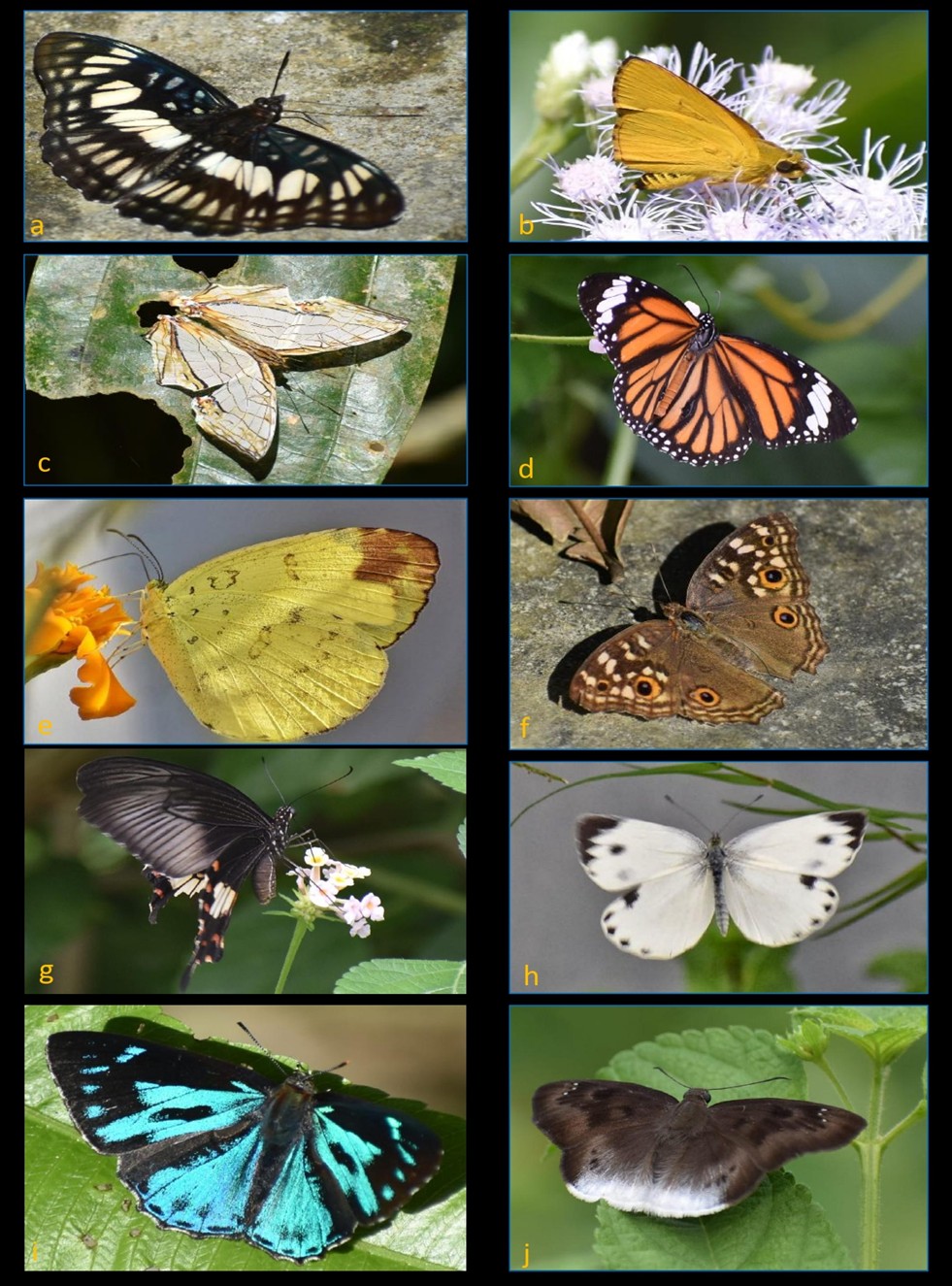
Fig 6. a. Blackvein Sergeant (Athyma ranga), b. Wax dart (Cupitha purreea), c. Map Butterfly (Cyrestis thyodamas), d. Striped Tiger (Danaus genutia), e. Three-spot Grass Yellow (Eurema blanda), f. Lemon pansy (Junonia lemonias), g. Common Mormon (Papilio polytes), h. Indian Cabbage White (Pieris canidia), i. Common gem (Poritia hewitsoni), j. Common Snowflat (Tagiades japetus)
Conclusion
The presence and absence, distribution and diversity pattern of butterflies in the Borajan- Bherjan-Podumani Wildlife Sanctuary establishes a correlation of butterfly abundance with the habitat of the region. The findings obtained from this study reflect the availability of diverse habitats, which overall facilitate favourable conditions for the survival of butterflies belonging to different families in the Borajan-Bherjan-Podumani Wildlife Sanctuary.
The study also reflects that intact and connected habitats such as wildlife sanctuaries and other protected areas are richer in terms of butterfly species [14], [32]. This emphasizes the importance of safeguarding forest fragments and the need for more effective conservation measures, such as a combination of scientific research, habitat management, protection of host and nectar plants, maintenance of habitat connectivity, and involvement of local communities in the management plans for the preservation of butterfly diversity and the overall integrity of the ecosystem [33]. High abundance of the Nymphalidae family and the presence of 14 species protected under different wildlife protection act has also proved that the area is highly diverse and has a beneficial ecological role, and should be explored more for conserving this unexplored wildlife sanctuary in the district. Despite its relatively small geographic area, the Borajan-Bherjan-Podumani Wildlife Sanctuary harbours a remarkably rich butterfly fauna, including the protected species. This sanctuary has been unexplored and undocumented in terms of studies on butterflies, and this current study represents the first systematic documentation on butterfly diversity from this area. Hence, the findings and results highlights need for further long-term monitoring and conservation planning and management strategies for this lesser-known but diversity-rich wildlife sanctuary.
Declarations
Conflict of interest: The author declares that there are no financial, personal, professional, or Institutional relationships that could be perceived as a conflict of interest or as having influenced the research or its interpretation in this manuscript.
References
[1] Ghazanfar, M., Malik, M.F., Hussain, M., Iqbal, R., and Younas, M. (2016). Butterflies and their contribution in ecosystem: A review. Journal of Entomology and Zoology Studies, 4(2), 115-118. [Link]
[2] Rahman, S., and Biswas, B. (2025). Population dynamics of butterflies in rural-urban ecosystems: A case study at Assam down town University in the northeastern region of India. Insect Conservation and Diversity, 19(1), 40-55. [Link]
[3] Joshi, P.C., and Arya, M. (2007). Butterfly communities along altitudinal gradients in a protected forest in the Western Himalayas, India. The Natural History Journal of Chulalongkorn University, 7(1), 1-9. [Link]
[4] Topp, E.N., Tscharntke, T., and Loos, J. (2021). Fire and landscape context shape plant and butterfly diversity in South African shrubland. Diversity and Distributions. [Link]
[5] Robinson, G.S., Ackery, P.R., Kitching, I.J., Beccaloni, G.W., and Hernandez, L.M. (1997). Biodiversity of butterflies (Lepidoptera): Inventory and monitoring methods. Journal of Insect Conservation, 1, 45-62. [Link]
[6] Das, M., Ghosh, S., Karmar, A., Chakraborty, A., Chakraborty, T., Dutta, S., Sarkar, R., Ghosh, A., and Manna, T. (2026). Butterfly (Lepidoptera) diversity and community structure in Kohka, adjacent to Turia Gate, Pench National Park, Madhya Pradesh, India. Uttar Pradesh Journal of Zoology, 47(3), 262-278. [Link]
[7] Mohapatra, A., Rath, L.P., and Parida, S.P. (2012). A preliminary study on butterfly diversity in Garbhanga Reserve Forest, Basistha, Assam, India. Journal of Entomology and Zoological Studies, 1(2), 45-50. [Link]
[8] Kehimkar, I. (2016). The Book of Indian Butterflies. Mumbai: Bombay Natural History Society. [Link]
[9] Majumder, J., and Lodh, R. (2013). Butterfly species richness and diversity in the Trishna Wildlife Sanctuary in South Asia. Journal of Insect Science, 13(1), 79. [Link]
[10] Assam State Biodiversity Board. (2013). Glimpses of biodiversity in Assam. Guwahati: Assam State Biodiversity Board. [Link]
[11] Evans, W.H. (1932). The Identification of Indian Butterflies (2nd ed.). Bombay: Bombay Natural History Society. [Link]
[12] Talukdar, S., and De, A. (2013). Butterfly diversity in two different habitats in the vicinity of Assam University Campus, Silchar, Assam. A Journal of Environment and Biodiversity, 4, 11-13. [Link]
[13] Gogoi, M.J. (2013). A preliminary checklist of butterflies recorded from Jeypore-Dehing forest, eastern Assam, India. Journal of Threatened Taxa, 5, 3684-3696. [Link]
[14] Bora, A., and Boruah, A. (2015). Diversity and seasonal abundance of swallowtail butterflies population in Dangori Reserve Forest, Tinsukia district, Assam, India. Photon: The Journal of Biodiversity, 11, 453-460. [Link]
[15] Wilson, E.O. (1997). Introduction. In M.L. Reaka-Kudla, D.E. Wilson, and E.O. Wilson (Eds.), Biodiversity II: Understanding and protecting our biological resources (pp. 1-3). Washington, DC: Joseph Henry Press. [Link]
[16] Kaushik, K.K., Saba, P., and Chutia, B.C. (2020). Diversity and abundance of butterflies in and around Sivasagar tank (Borpukhuri), in Sivasagar District, Assam, India. Ecology, Environment and Conservation, 26(1), 135-141. [Link]
[17] Saikia, M.K. (2014). Diversity of tropical butterflies in urban altered forest at Gauhati University Campus, Jalukbari, Assam, India. Journal of Global Biosciences, 3(3), 452-463. [Link]
[18] Government of Assam. (1999). No.FRW.57/99/46 - Bherjan-Borajan-Padumoni Wildlife Sanctuary. Principal Chief Conservator of Forest & Head of Forest Force, Government of Assam. [Link]
[19] Singh, A.P. (2017). Butterflies of Eastern Assam, India. Journal of Threatened Taxa, 9(7), 10396-10420. [Link]
[20] Assam Tourism. (2026). Borajan-Bherjan-Padumoni. Department of Tourism, Government of Assam. [Link]
[21] Pollard, E. (1992). Monitoring butterfly numbers. In F.B. Goldsmith (Ed.), Monitoring for Conservation and Ecology. London: Chapman and Hall. [Link]
[22] Kunte, K., Sondhi, S., and Roy, P. (2017). Butterflies of India. Indian Foundation for Butterflies. [Link]
[23] Colwell, R.K. (2023). EstimateS: Statistical estimation of species richness and shared species from samples, version 9. User’s Guide and application website. [Link]
[24] Shannon, C.E., and Weaver, W. (1949). The Mathematical Theory of Communication. Urbana: University of Illinois Press. [Link]
[25] Pielou, E.C. (1966). The measurement of diversity in different types of biological collections. Journal of Theoretical Biology, 13, 131-144. [Link]
[26] Gogoi, M.J., Singha, H.J., and Deb, P. (2016). Butterfly (Lepidoptera) diversity in Barail Wildlife Sanctuary, Assam, India. Journal of Entomology and Zoology Studies, 4(4), 547-550. [Link]
[27] Joshi, R.K., and Dhyani, S. (2014). Butterflies diversity, distribution and threats in Dibru-Saikhowa Biosphere Reserve, Assam, North-East India: A review. World Journal of Zoology, 9(4), 250-254. [Link]
[28] Saikia, M.K., Kalita, J., and Saikia, P.K. (2009). Ecology and conservation needs of nymphalid butterflies in disturbed tropical forest of Eastern Himalayan biodiversity hotspot, Assam, India. International Journal of Biodiversity and Conservation, 1(7), 231-260. [Link]
[29] Mukherjee, D., Naik, D., Rao, R.S.P., Kunte, K., and Mustak, M.S. (2022). Seasonal dynamics and polyphenism of butterfly communities in the coastal plains of central Western Ghats, India. Journal of Biosciences, 47, 79. [Link]
[30] Gogoi, R., Chetry, A., and Bhuyan, A. (2023). Diversity and species richness of butterfly in Soraipung Range of Dehing Patkai National Park, Assam, India. The Journal of Basic and Applied Zoology, 84(1), 6. [Link]
[31] Blair, R.B., and Launer, A.B. (1997). Butterfly diversity and human land use: Species assemblages along an urban gradient. Biological Conservation, 80(1), 113-125. [Link]
[32] Wagner, K.D., Krauss, J., and Steffan-Dewenter, I. (2013). Butterfly diversity and historical land cover change along an altitudinal gradient. Journal of Insect Conservation, 17, 1039-1046. [Link]
[33] Wang, W.L., Suman, D., Zhang, H.H., and Xu, Z.B. (2020). Butterfly conservation in China. Insects, 11, 661. [Link]