

Lichens of Dhing, Nagaon District, Assam
1Sanjeeb Kumar Nath, 2Manoj Kumar Saikia, 3Uddhab Talukdar, 4*Mousumi Terangpi
1, 2 & 3Advance Institutional Level Biotech Hub, Phase II, Dhing College, Nagaon, Assam
4Department of Botany, Dhing College, Nagaon, Assam
*Corresponding author: mousumiterangpi52@gmail.com
Abstract
Lichens are symbiotic associations between a fungus and an alga or, in some cases, a cyanobacterium. This partnership enables both organisms to persist in habitats such as bare rocks or tree bark, where neither could survive independently. Due to their sensitivity to environmental changes, lichens serve as reliable bioindicators for monitoring ecosystem health and air quality. Their presence and diversity in a region provide valuable insights into local environmental conditions. The present study documents the diversity and distribution of lichens in Dhing town, Nagaon district, Assam, with particular emphasis on the Dhing College campus and adjacent areas. The region, characterized by a humid tropical monsoon climate and rich vegetation cover, offers favorable conditions for the growth and establishment of diverse lichen communities. The varied vegetation structure and availability of suitable host trees further contribute to the richness of epiphytic lichen communities. The observed diversity and abundance of lichens indicate favorable microclimatic conditions and relatively low levels of air pollution in the region. These findings provide baseline data on lichen diversity in Dhing and highlight the significance of lichens as indicators of environmental quality.
Key Words: Lichen, Bioindicators, Dhing, Assam
Introduction
India supports an estimated 89,450 described species of living organisms, representing approximately 7.3 percent of global biodiversity (Rout et al., 2010). Lichens constitute a significant component of this diversity, with over 2,900 documented species, which accounts for 14.8 percent of the globally recognized lichen species (19,500 species) within the phylum Ascomycota. Of these, about 540 species (over 18 percent) are endemic to India. Notably, only a single species from the Basidiomycota group, Dictyonema irpicatum (Berk & M.A. Curtis) Lücking, has been recorded in the country (Botanical Survey of India, 2021). Lichens in India inhabit a wide range of substrates, such as tree bark, rocks, soil, decaying wood, living leaves, and other surfaces, and are distributed across eight lichen geographical regions: the Eastern Himalayas, Western Himalayas, Western Ghats, Andaman and Nicobar Islands, Central India, Gangetic Plains, Western Dry Region, and the Eastern Ghats-Deccan Plateau. The Eastern Himalayas and Western Ghats are identified as the most biodiverse regions for lichens in India. While India is estimated to harbours approximately 2,040 lichen species (Awasthi, 2000), recent research indicates that actual diversity may be considerably higher due to underexplored areas and the presence of cryptic species (Hawksworth, 2001; Upreti et al., 2015). Lichens are unique organisms characterized by a symbiotic association between fungi and algae or cyanobacteria (Ahmadjian, 1993). The present study aims to document the lichen diversity within the Dhing College Campus. Although lichens play an important ecological role, the diversity in this region remains insufficiently documented, and numerous species are likely yet to be identified. The area's humid climate, substantial annual rainfall, and moisture-laden monsoon winds from the Bay of Bengal provide optimal conditions for lichen proliferation. Furthermore, the varied topography and elevation enhance their abundance. Despite the rich lichen diversity, northeastern India remains significantly understudied. Ongoing deforestation poses a critical threat, potentially resulting in the irreversible loss of undiscovered lichen species before they can be scientifically described (Ramakantha et al., 2003).
Material and Methods
Study Area
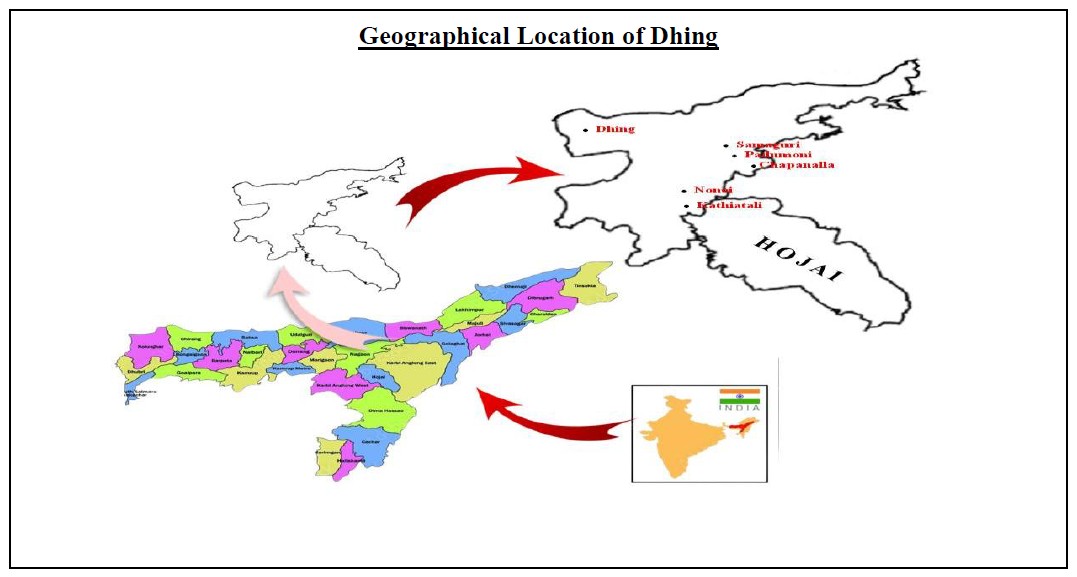
Dhing town is located approximately 25 kilometers from Nagaon town. The study was conducted at different locations in Dhing town, situated in the Nagaon district of Assam, India, with a focus on the Dhing College campus, Dhing Chariali and Dhing Bazar area. Host plant species included viz., Plumeria alba, Terminalia arjuna, Gmelina arborea, Aquilaria malaccensis, and Tectona grandis, etc.,
Climatic Condition
The region experiences a tropical monsoon climate characterized by abundant rainfall and consistently high humidity. Distinct seasonal variations are evident, with hot summers and comparatively cooler winters. Sky conditions vary significantly throughout the year; February generally exhibits the clearest skies, whereas July is predominantly overcast (India Meteorological Department, 2023).
Methods of Sample Collection
The field survey was conducted from November 2023 to February 2024. A stratified random sampling approach was employed to cover different microhabitats within the study area, including roadside plantations, campus gardens, and shaded tree stands. Samples were collected from twigs and stems of various tree species with well-colonized lichens. Following standard protocols, samples were packaged in zip-lock plastic bags and labeled with collection number, date, location, host species, and habitat characteristics for transport to the laboratory (Orange et al., 2010).
Method of Data Analysis
Collected specimens were air dried at room temperature and cleaned to remove extraneous debris. Preliminary identification was based on morphological and anatomical characteristics such as thallus form, color, surface texture, and reproductive structures. Final taxonomic identification was performed by the ICFRE-Bamboo and Rattan Centre, Aizawl, Mizoram. Voucher specimens have been deposited in the Advance Institutional Biotech Hub, Dhing College herbarium, Nagaon, Assam, to serve as a permanent reference collection for future research and student training.
Results and Discussion
A total of 13 lichen species (Table 1.) were documented in Dhing Town, Nagaon district, Assam, representing three primary growth forms: crustose, foliose, and fruticose. Among these, six species were crustose, six were foliose, and one was fruticose. The lichens predominantly colonized the bark, twigs, and stems of roadside campus trees, particularly Plumeria alba, Terminalia arjuna, Gmelina arborea, Aquilaria malaccensis, and Tectona grandis. (Fig. 2) presents the relative distribution of these growth forms. Crustose and foliose lichens each constituted 46.15 percent of the total species, while fruticose lichens comprised 7.70 percent. The dominance of crustose and foliose lichens suggests favorable environmental conditions with relatively low pollution levels, consistent with findings from other tropical regions (Saipunkaew et al., 2005). Crustose lichens typically tolerate higher light exposure and variable moisture, whereas foliose lichens generally require moderate shade and stable humidity (Ahmadjian, 1993; Orange et al., 2010). The presence of a fruticose lichen, which is generally more sensitive to air pollutants, further supports the conclusion that the study area maintains good air quality (Rout, 2007).
The lichen diversity observed in Dhing town aligns with findings from comparable surveys in northeastern India and other tropical regions. Research from southern Assam and neighboring areas has documented a predominance of crustose and foliose epiphytic lichens in semi-urban landscapes characterized by substantial vegetation cover (Rout et al., 2010; Nayaka et al., 2002). Furthermore, semi-urban environments with minimal industrial activity and moderate vehicular traffic generally support relatively diverse lichen assemblages (Saipunkaew et al., 2005). The present results support the importance of campus ecosystems and roadside plantations as refuges for cryptogamic biodiversity, particularly in fast-growing urban regions.
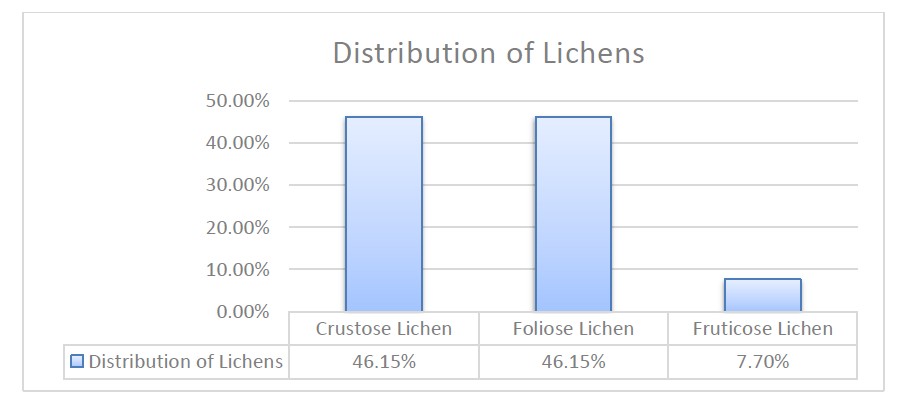
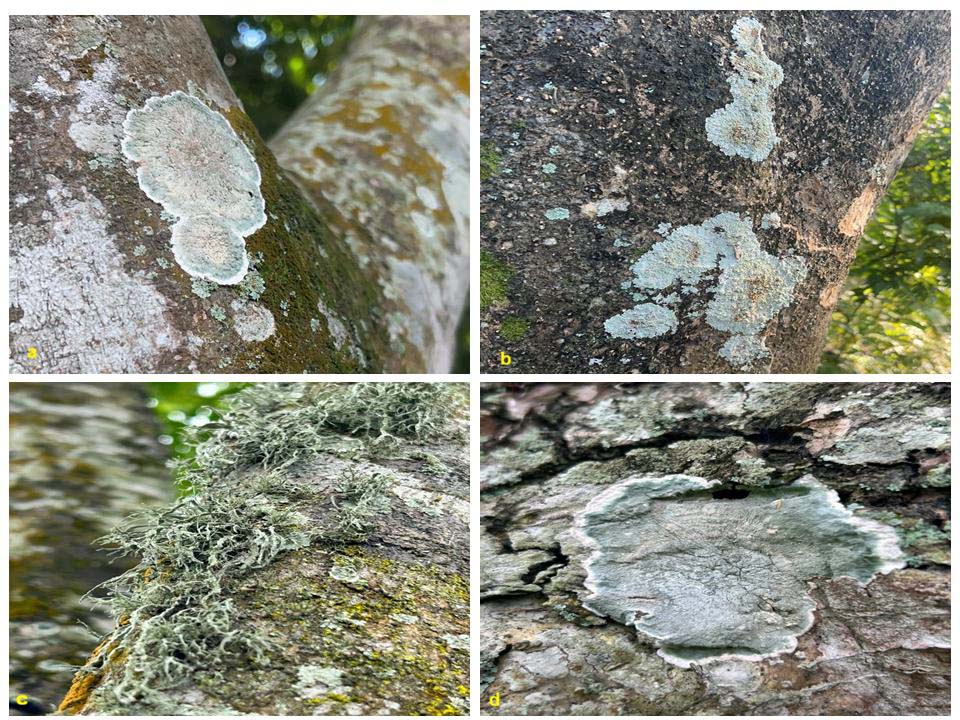
Table 1: List of Lichens recorded from Dhing town, Nagaon district, Assam, with collection detail
| Sl No. | Collection No. | Scientific Name | Family | Growth Form | Host Species | Collected from |
|---|---|---|---|---|---|---|
| 1 | DC/L/01 | Oxneriopsis bassiae (Ach.) S.Y. Kondr.Upreti&Hur |
Teloschistaceae | Crustose | Plumeria alba L. | Dhing College campus |
| 2 | DC/L/02 | Cryptothecia striata Thor. | Arthoniaceae | Crustose | Terminalia arjuna (Roxb. ex DC.) Wight & Arn. | Dhing College campus |
| 3 | DC/L/03 | Graphina rufopallida (Vain.) Zahlbr. | Graphidaceae | Crustose | Gmelina arborea Roxb. | Dhing Chariali, Roadside |
| 4 | DC/L/04 | Chrysothrix candelaris (L.) Laundon | Chrysotricaceae | Crustose | Aquilaria malaccensis Lam. | Dhing Chariali, Roadside |
| 5 | DC/L/05 | Graphis nigroglauca Leighton. | Graphidaceae | Crustose | Tectona grandis L.f. | Dhing Chariali, Roadside |
| 6 | DC/L/06 | Bacidia incongruens (Stirton) Zahlbr. | Ramalinaceae | Crustose | Plumeria alba L. | Roadside |
| 7 | DC/L/07 | Parmotrema tinctorum (Nyl.) Hale | Parmeliaceae | Foliose | Terminalia arjuna (Roxb. ex DC.) Wight & Arn. | Dhing College campus |
| 8 | DC/L/08 | Pyxine sorediata (Ach.) Mont. | Caliciaceae | Foliose | Gmelina arborea Roxb. | Roadside |
| 9 | DC/L/09 | Pyxine cocoes (Sw.) Nyl. | Caliciaceae | Foliose | Plumeria alba L. | Dhing Chariali |
| 10 | DC/L/10 | Pyxine reticulata (Vain.) Vain. | Caliciaceae | Foliose | Tectona grandis L.f. | Dhing Bazar |
| 11 | DC/L/11 | Parmotrema praesorediosum (Nyl.) Hale |
Parmeliaceae | Foliose | Aquilaria malaccensis Lam. | Roadside |
| 12 | DC/L/12 | Dirinaria papillulifera (Nyl.) D.D. Awasthi |
Caliciaceae | Foliose | Terminalia arjuna (Roxb. ex DC.) Wight & Arn. | Dhing College campus |
| 13 | DC/L/13 | Unidentified | —— | Fruticose | Gmelina arborea Roxb. | Dhing College campus |
Acknowledgement
We sincerely thank the DBT, Govt. of India for financial support in Establishment of Advance Institutional Level Biotech Hub, Phase II, Dhing College (Sanction No. BT/NER/143/SP44313/2021 Dated: 01/02/2023) for financial support. The authors also thankfully acknowledge the ICFRE-Bamboo and Rattan Centre (A unit of ICFRE-FRRI, Jorhat, Assam), Bethlehem Vengthlang, Aizawl, Mizoram - 796008 for providing the support and herbarium facilities.
Declaration
Conflict of Interest: The authors declare that they have no conflict of interest.
References
- Ahmadjian, V. (1993). The lichen symbiosis. John Wiley & Sons.
- Awasthi, D. D. (2000). A handbook of lichens. Bishen Singh Mahendra Pal Singh.
- Botanical Survey of India. (2021). Lichens of India. Ministry of Environment, Forest and Climate Change, Government of India.
- Hawksworth, D. L. (2001). The magnitude of fungal diversity: The 1.5 million species estimate revisited. Mycological Research, 105(12): 1422–1432. https://doi.org/10.1017/S0953756201004725
- India Meteorological Department. (2023). Climate of Assam. Ministry of Earth Sciences, Government of India.
- Nayaka, S., Upreti, D. K., & Yadav, V. (2002). An enumeration and new records of lichens from Sirmaur District, Himachal Pradesh, India. Phytotaxonomy, 2: 49–63.
- Orange, A., James, P. W., & White, F. J. (2010). Microchemical methods for the identification of lichens. British Lichen Society.
- Ramakantha, V., Gupta, A. K., & Kumar, A. (2003). Biodiversity of northeast India: An overview. In A. K. Gupta, A. Kumar, & V. Ramakantha (Eds.), Envis bulletin: Wildlife and protected areas—Conservation of rainforests in India (pp. 1–24). Ministry of Environment and Forests, Government of India.
- Rout, J. (2007). Air pollution biomonitoring: Lichens as indicator species. In P. Dwivedi, S. K. Dwivedi, & M. C. Kalita (Eds.), Biodiversity and environmental biotechnology (pp. 13–54). Scientific Publishers.
- Rout, J., Das, P., & Upreti, D. K. (2010). Epiphytic lichen diversity in a reserve forest in southern Assam, northeast India. Tropical Ecology, 51(2), 281–288.
- Saipunkaew, W., Wolseley, P., & Chimonides, P. J. (2005). Epiphytic lichens as indicators of environmental health in the vicinity of Chiang Mai City, Thailand. The Lichenologist, 37, 345–356.
- Upreti, D. K., Divakar, P. K., Shukla, V., & Bajpai, R. (2015). Recent advances in lichenology: Modern methods and approaches in lichen systematics and culture techniques. Springer.
**************