
Weaving Process Among the Mising Tribe of Assam
Naba Kumar Pegu *
Department of Anthropology, Silapathar Science College, Silapathar, Dhemaji
* Corresponding address: nabakash@gmail.com
Abstract
Weaving or textile are very sacred and culturally significant craft among the Mising people of Assam, largely the Mising tribes residing along the banks of the Brahmaputra River. Traditionally practiced by women, textile manufacture characterizes an essential part of Mising identity, heritage, and social life. The craft comprises complex and systematic process, including Sizing (Mar-diya), Dyeing (Rang-kora), Thread preparation (Huta), and Winding (Youghuwa). In the study present study recorded the use of two traditional looms—the mini (loin) loom and the throw shuttle loom, additional current looms viz., fly shuttle, jacquard, and dobby are also practices by Mising tribe. The earliest designs and practices reflect the community’s rich traditions and serve as significant cultural signs, preserving their customs and continuity across generations.
Key Words:Textile, The Misings
Introduction
Weaving or textile is an important component of human civilization since it is related to meeting the basic needs of human life. It is one of the most important parts of the women life. It is a specialized art of women who produce variety of cloth. It is a complex process, and it involves many activities. It is the production of fabric by interlacing two sets of yarns, so that they cross each other normally at right angles, usually accomplished with a hand or a power-operated loom. Lengthwise yarns are called wrap; crosswise yarns are called weft or filling. The two are interwoven on a device known as loom. A finished textile is not only a product of loom, but a chain of integrated process starting from growing or rearing of cotton to the finished product passing through the various stages of yarn of production, clearing, drying, spinning and weaving. The most common method for converting yarn into fabrics is by weaving or textile, that is by the interlacing of threads or yarns into a bound system. The term ‘textile’ derived from a Latin word ‘taxere’, this means ‘to weave’. It is a very complex process. It involves many activities.
Assam is the most notable state in N.E. India for many tribal people. The Misings, one of the major tribes and second largest schedule tribe (ST) of Assam [1], [2], [3]. Majority of them are residing in the plains along the bank of the river Brahmaputra. They belong to Tibeto-Burman family of the great Mongoloid race. They have been maintaining some of their traditional customs and practices. Agriculture is their main livelihood. They have been gradually assimilating themselves with other indigenous people of the plains of Assam and their culture [1], [2], [3]. They have their own rich traditions, and the handloom textile is one of those distinctive features [2], [4], [5]. The weaving or handloom textile represents the traditional legacy of the Mising women [2], [4], [5]. They produce beautiful patterns of wrappers, shauls, mekhelas, rihas etc. They also have a good knowledge of natural dyes [2], [4], [5]. So, weaving or textiles is an occupation of the womenfolk of the Misings or the most important features of the Misings. Its designs have been a very ancient art in their society. It is a cultural sign of them. They even give certain patterns and designs of simple standards from their own ideas. It is one of the most important parts of their society. Their weaving is especially significant because it is part of the community’s attempt to be self-sufficient. The weaving processes of them are very elaborate and they can produce a large quantity of cloth in minimum time [2], [4].
By dint of their hard work, knowledge, experience, imagination and skill, the Mising women can weave varieties of clothes for use to all members of the family, having designs of artistic beauty. All the dresses, especially of the women, are the product of loom. The typical usage of design, unique colour combinations and selection of motifs prominently characterize their clothes. Their clothes are exclusively designed using different colour threads, like black, red, green, orange, yellow, white, blue, brown etc. They even give certain patterns and designs of simple standards from their own idea [2], [4], [5].
It is ascertained from the investigations that, the weavers of the Mising could make the designs by watching natural objects like the stars, the moon in the sky, flowers of different varieties of nature, picture of birds, animals, fishes, butterfly, historical monuments, and so forth [4].
H. Barua (1951) observed that, the skill of art in the weaving and spinning had always been held to be one of the highest attainments of an Assamese women. Choudhury (1959) observed the production of silk and the silk trade in Assam. Baishya (1989) highlighted the decaying condition of traditional industries in his book, Small and Cottage Industries, A Study in Assam and advocated their modernization; so that the socio-economic system does not face labour alienation [6].
S. N. Choudhury (2001) observed that, the weaving sector has to improved and revamped by introduction of better looms, employing skilled and are artisans having proper expertise of silk weaving. Pegu (2005) [2] observes that, the Mising hand woven dresses are –Gadu/Mirijim, Ribi, Gaseng, Gero, Yambo, Tongali, Tapum Gasor (different types of clothes) etc. Regon (2007) observes the changing trend and preservation methods of the Mising hand woven dresses. T. Ch. Pamegam (2015), mention that originally the whole Mising dresses or clothes are made from their cultivating cotton tree. B. K. Doley (2015) [4], remark that Gadu or Mirijim is a symbol of status and dignity of family in the Mising society. It is a cotton product, requires a lot of labour and care in its weaving process [4].
J. J. Kuli (2015) [5], stated that, the Mising usually use two types of looms for weaving, a mini loom and a common ordinary loom. They weave different types of clothes like Gadu, Sogon, Mibo or Mibu galug, Lingkog, Ribi, Gaseng, Gonro ugon, Gontung ugon, Gonbor, Gadu galug, Tukog salu, Lingkab, Erib, Gero, Yambo, Poniyang gasor, Pe’re, Kegr’g or Se’gre’g, Dume’ etc. which have their different traditional designs [5].
Material and Methods
The present study was conducted in 2025, in certain villages under the Sissibargaon Development Block of Dhemaji district, Assam, where the Mising community is predominantly concentrated. The selection of the study area was based on demographic, anthropogenic, and ethnic criteria. Primary data were collected through structured questionnaires administered to Mising women respondents, and the information was systematically recorded.
In addition, secondary data were reviewed and analyzed to supplement the primary findings. Relevant historical information about the area, along with other associated socio-cultural aspects, was gathered mainly through interviews with elderly members of the local communities. The research adopted exploratory and descriptive methodologies and was qualitative in nature.
Results and Discussion
The Mising women are very expert in textile. Handloom is a simple machine. It can be adjusted to weave from a simple plain piece of fabric to a varied and complex artistic pattern, but the beauty of its production depends largely upon the manual skill of the weaver. It will be interesting to note here that in the weaving of the finest quantity of cloth and the most delicate pattern with extra weft, a handloom always proves to be a better and more successful means in comparison to a power loom.
The weavers of the Mising usually used two types of looms for weaving or textile. These are - a mini or loin loom and a common ordinary loom or throw shuttle loom. But nowadays, they also used Fly shuttle loom, Jacquard loom and Dobby loom. In some industries among the Mising community the power loom is also found to be in use. The mini or loin loom is a part and parcel of the Mising textile. The loom has no frame or upper structure, but it consists of two vertical bamboo or wood poles kept horizontally. A few pieces of stout bamboo and wooden rods of varying thickness with a wooden beating sword are used as accessories of the loom [3], [5].
The mini or loin loom is a very simple and portable loom used conveniently for weaving like Gadu (Mirijim), Gapa, Mibu/Mibo galug, Gale, Sogon like muna or bag), Lingkab/Erkog (muffler) etc. even in leisurely hours. The common ordinary loom or throw shuttle loom is common in every Mising house. It is used conveniently for weave varieties of cloth, for use to all members of the family having designs of artistic beauty. All the dresses, especially of the women, are the product of loom [5].
A common ordinary loom or throw shuttle loom is a variety of loom in which a simple shuttle. It is the most common and traditional loom used by all communities in Assam. Four wooden posts required for the loom are fixed firmly on the ground. The shuttle is thrown by hand through the shed of warp from one side and received by the other hand on the other side. It is the most common and traditional loom in the Mising. As observed, four bamboo or wooden posts required for loom are fixed firmly on the ground. The beating up of the weft is done by a bamboo or iron reed which has a sley [5].
Looming starts with drafting (Bo-Bharuwa) in which one (warp) ends and a pair of ends are drawn through the Heald-eye for the body and selvedge respectively for plain weaving. After this, ends are drawn through the dents of the reed. This is known as denting (Ras-Bharuwa). Hooks are used for this purpose. Further, the connections on the top of the healds are tied by cords over pulleys or other attachments like draw-bouy or dobby. These are used for designing. The connections on the bottom side of the heads are made by cords with the balanced rods and then to the treads.
Manufacturing Process
For the manufacturing process, there are some preliminary treatments that are essential for a successful finishing. These are as follows:
a. Sizing (Mar-diya)
A certain amount of stiffness in the yarn as well as in the washed clothes gives them a smooth glossy surface which is resistant to dirt and dust. This process is known as sizing. Sizing involves a few steps, namely, starching, rinsing and drying. Sizing is done to yarn as well as to cloths. It is done in order to strengthen and protect the materials during weaving. This exercise is generally undertaken for silk, i.e., cotton yarns and pat and Muga yarns. In the Tongani and Borghuli village, however, the frequent use of sizes includes wheat flour, rice starch, sogo, potato starch, barley etc. It is generally done by women.
b. Dyeing (Rang-kora)
The world of textiles without colour is almost unimaginable. Earlier man depended on plants and insects for his supply of colour, but today with the availability of synthetic dyes, there are hundreds of colours to choose. Dyes are soluble substances, which penetrate the fibre and are fixed by chemical action, heat or other treatment. Dyeing is done at various stages of fabric production before spinning (fibre stage), after reeling and spinning (yarn stage) and after weaving (cloth or fabric stage).
Fibre dyeing refers to the addition of dye to the loose fibre before spinning. Yarns are dyed in hanks (nesha) or packages before weaving. When dye is applied to the finished fabric it is known as piece dyeing. During the present investigation it has been observed that the weavers generally use resources to yarn dyeing in hank form.
c. Thread (Huta)
Each cloth is made from wool, cotton and Endi. The Misings of the Tongani and Borghuli village rarely rear some type of larva (Endi and Muga). Some villagers buy readymade yarn from the market. Regarding other threads, they buy from the market of Silapathar town. They do not face any inconvenience in buying yarn, as these are easily available in the market.
d. Winding (Youghuwa)
The yarn in the hank form is not always suitable for preparation of warp. It is therefore necessary that the yarn from the hanks has to be converted to a suitable form so as for convenience to prepare warp.
In some villages in Assam, from a stand of Spool (Sereki), the yarn is transferred to Bobbin (Ugha) with the help of Putol(Temple). The yarns are also moved on Pirns (Mahura) with the help of Spin/Charkha (Jotor) for the purpose of weaving.
Conclusion
At the present time there is growing impact of science and technology, in one or other way in weaving industry of the Mising society. The necessity to produce cotton plants in the fields for yarns has reduced considerably because of the easy availability of variable qualities of cotton threads in the market; and lack of expert and dedicated weavers in society. Moreover, the repeated effect of floods of the Brahmaputra and its tributaries has inundated a major portion of high fertile lands suitable for cotton cultivation in the Mising inhabited rural areas. For these reasons they have become reluctant to produce cotton in their limited cultivating land. Therefore, the different Mising organizations, N.G.O. and the Handloom Textile Department of Assam must need to take positive response for preservation and future development of this culture.
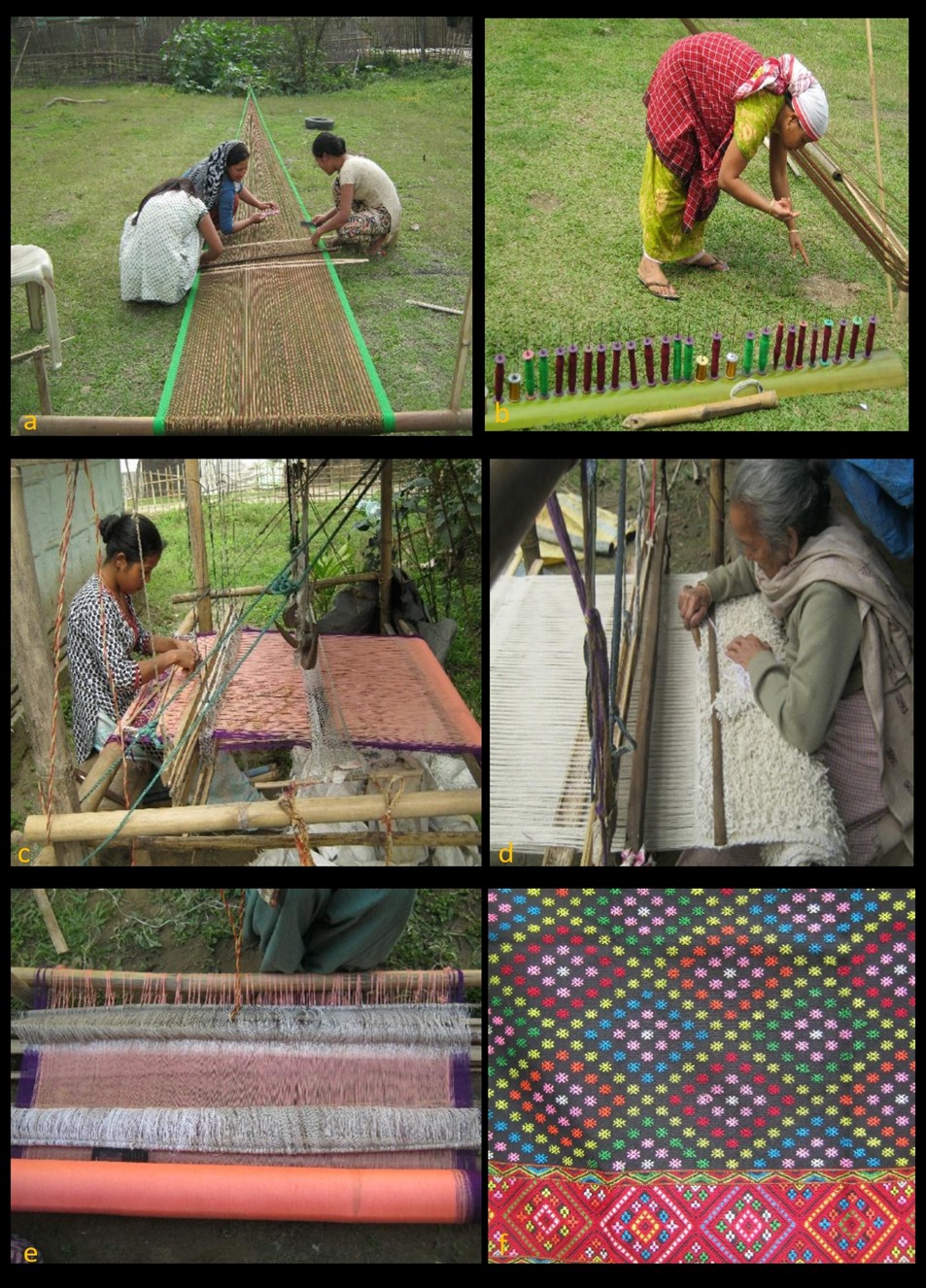
Fig: 1. a. Three Mising girls winding thread; b. A women winding thread for weave; c. A girl busy in designing; d. An old woman weaves Gadu (Mirijim); e. A scene of Mising handloom textile; f. A Mising Mekhela (Loin cloth) with with a traditional design
Declaration
Conflict of Interest:The author declare that they have no conflict of interest.
References
- Doley, D. (1973). The Socio-Economic Life of the Miri Tribe. North-Eastern Research Bulletin, 4 (Summer).
- Pegu, N. C. (2005). The Misings of the Brahmaputra Valley. Monumati Pegu. Google Books
- Doley, P. (2014). Changing Cultural Practices among the Rural and Urban Mising Tribe of Assam, India. IOSR Journal of Humanities and Social Science (IOSR-JHSS), 19(11), 26–31. IOSR PDF
- Doley, B. (2014). Glimpses On Mising Folk Cultures (pp. 5–15). Mirco-Migang Publications, 5–15.
- Kuli, J. J. (2015). The Mising Sanskriti (Vols. 1–2). Kaustubh Prakashan.
- Baishya, P. (1989). Small and Cottage Industries: A Study in Assam. Manas Publications. ISBN 81-7040-024-3.